
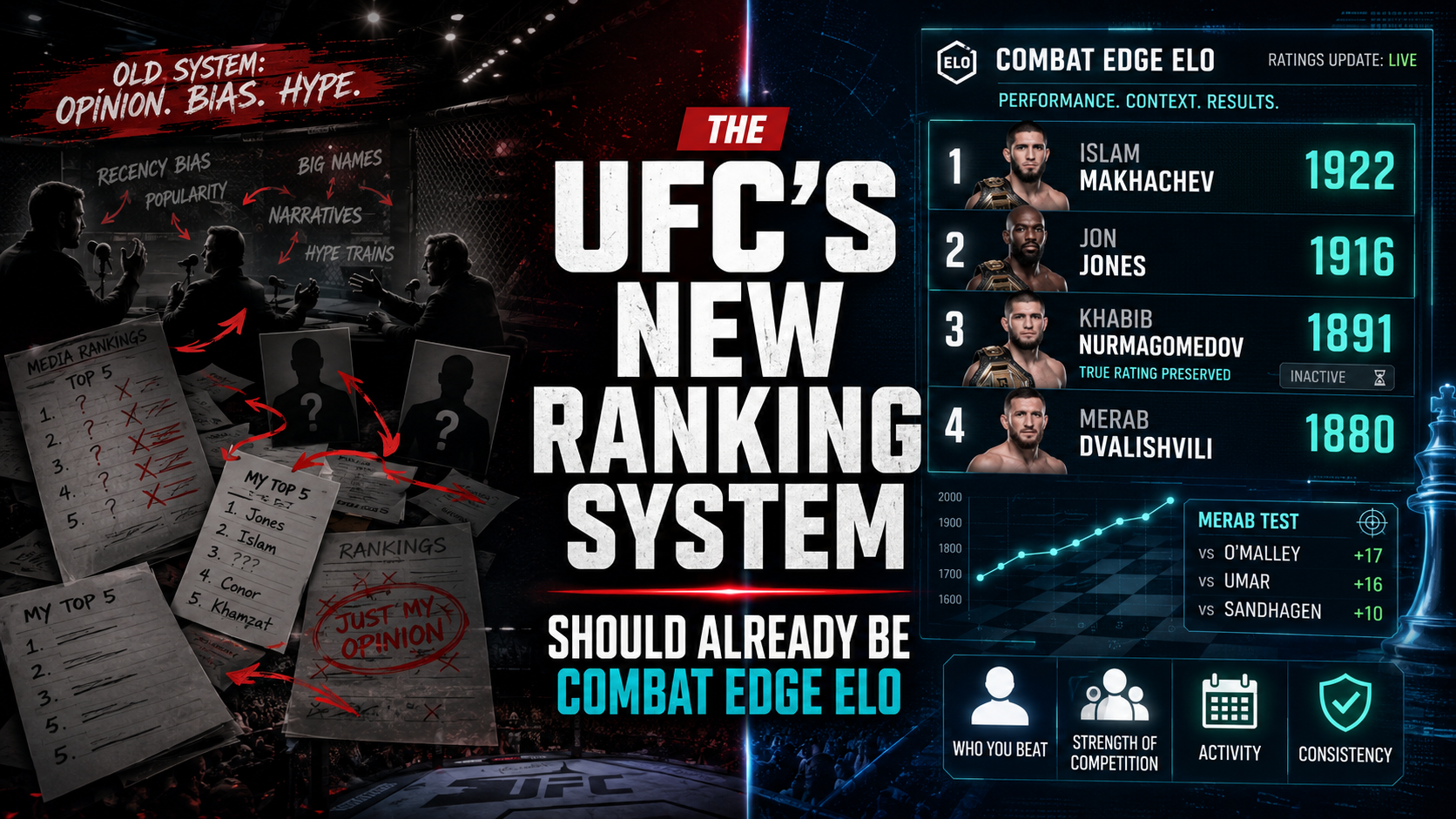
On Saturday, during the UFC Vegas 118 broadcast, the promotion confirmed what Dana White has been pushing for years: the UFC is moving off its media-panel rankings toward a new system based on measurable performance, not opinion or popularity. White, who once said of the current rankings 'I can't take it anymore,' has even brought in Meta and AI to help strip human bias out of the process. The promised system is supposed to judge fighters on four things: who you beat, strength of competition, activity, and consistency.
Here's the thing: that system already exists. It's called Combat Edge Elo, and it has been ranking 4,007 professional MMA fighters across 14 divisions on exactly those principles — no committee required.
The reason an overhaul is so overdue is simple. Almost every MMA ranking still comes down to a group of people voting, and the moment humans vote you get everything that comes with humans: recency bias, hype, promotional politics, the fighter who cuts a great promo climbing over the fighter who quietly wins.
Combat Edge took the voting out of it. Instead of a panel, there's a formula — the same kind of rating system that ranks chess grandmasters. No opinions. No agenda. Just results, processed in the exact order they happened. Point for point, here's how it already delivers what the UFC says it's after:
- Who you beat — every win is opponent-adjusted
- Strength of competition — a win is worth your opponent's rating at the moment you beat them
- Activity — a capped inactivity adjustment after 18 months
- Consistency — one chronological rating built fight by fight, never rewritten
Here's how each piece works — and why it already does the job.
Everyone starts equal, and the math never forgets
Every fighter enters the system at 1500. Win a fight and you take points from your opponent; lose and you hand them over. Bouts are processed chronologically, so the rating you carry today is the sum of everything you've actually done in a cage — in sequence, the way it really unfolded.
Islam Makhachev sits at the top of the active board with a 1922 rating. That number isn't a hot take; it's the visible output of a 16-fight unbeaten run stretching all the way back to his last loss in 2015. The board logs every step. Over just the most recent three-year stretch of that streak, you can read the climb fight by fight: 1878 after his first win over Volkanovski in February 2023, then 1893 after the rematch, 1905 past Dustin Poirier, 1914 past Renato Moicano, and 1922 after Jack Della Maddalena. No committee decides he 'feels' like the best — the math says he is, and it shows its work.
The key detail most rankings miss: a win is only worth what your opponent was rated at that moment. Beating a 1900-rated killer is worth a fortune. Beating a 1500-rated newcomer barely moves the needle. And because fights are locked in chronologically, a fighter who gets good later doesn't retroactively inflate the value of an old win over them. The result stands exactly as it happened.
The Merab test: why the same win is worth wildly different amounts
This is where Elo stops being a theory and starts being smarter than the people arguing about it.
Merab Dvalishvili almost never finishes anyone — 16 of his 21 wins are decisions. That makes him the perfect way to see what the system actually values, because the method barely changes from fight to fight. The only thing that really moves is who's standing across the cage.
Watch three of his five-round unanimous-decision wins:
- Sept 2024 — beat reigning bantamweight champion Sean O'Malley: +17
- Jan 2025 — beat undefeated (18-0) Umar Nurmagomedov: +16
- Oct 2025 — beat top contender Cory Sandhagen: +10
Same fighter. Same method — a 25-minute unanimous decision every single time. Yet out-pointing the champion was worth nearly double out-pointing a very good lower-ranked contender. The system isn't counting wins; it's pricing them by who you beat. Take a decision off the best fighter in the division and Elo pays a premium. Take one off a lower-ranked name and it pays you fairly — but less.
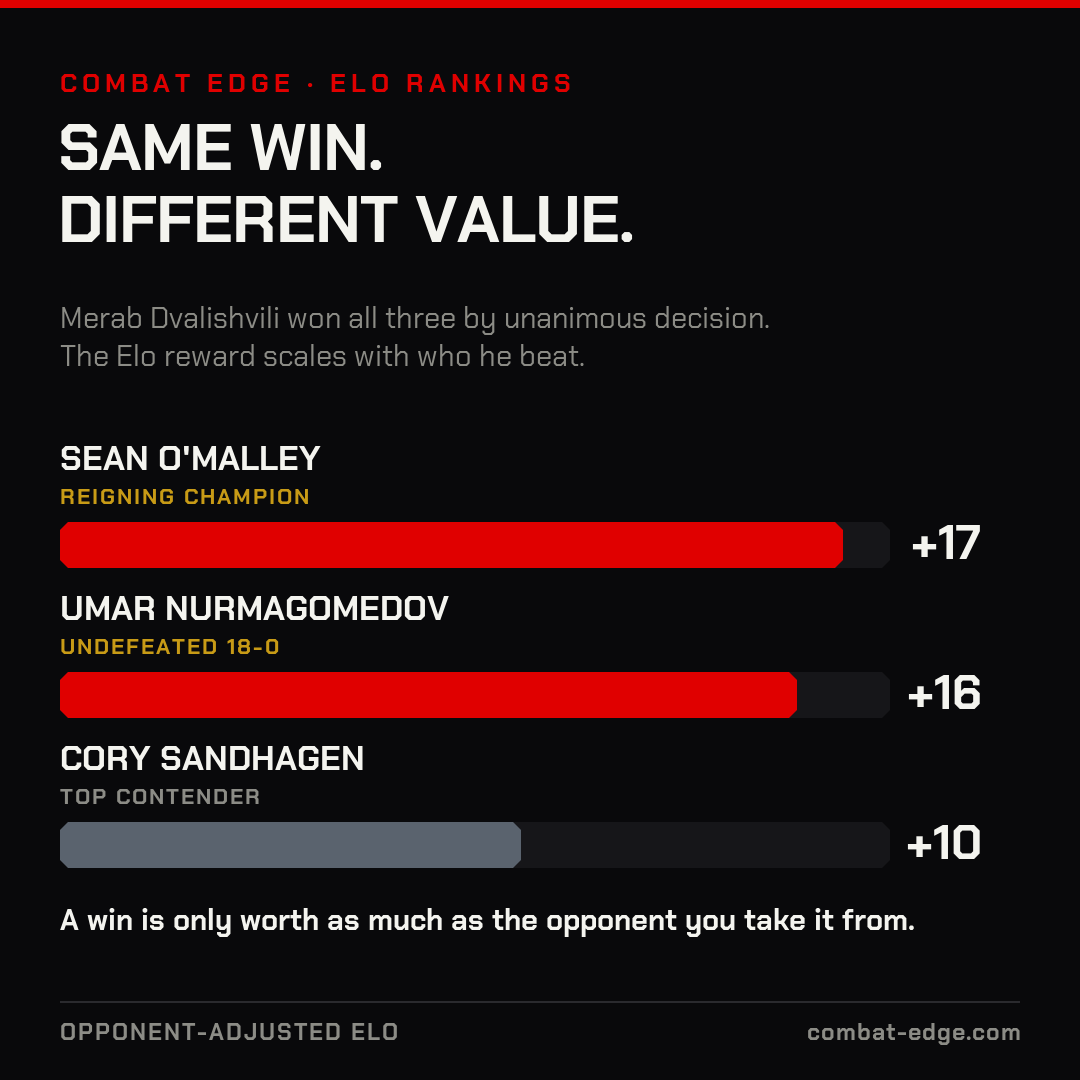
That's the entire case for opponent-adjusted ratings in one logbook: a win is only worth as much as the opponent you take it from. A win-loss record can't see that distinction — 20-4 looks identical whether you beat champions or journeymen. Elo sees almost nothing else.
Method matters — but it's a modifier, not the engine
None of that means how you win is ignored. It isn't. Finishes move ratings more than decisions, and a first-round finish moves them more than a late one. A split or majority decision — the kind that could've gone either way — moves the needle least. Dominance is rewarded; squeakers are treated like squeakers.
You can see the modifier at work in Merab's two wins over Sean O'Malley. The first, in 2024, was a decision while O'Malley was the reigning champion: +17. The rematch in 2025 was a submission — but by then O'Malley was a lower-rated former champ, so opponent-adjustment alone should have paid less. It paid +18 instead. The finish bonus more than canceled out the weaker opponent. Method is real; it's just a thumb on the scale, not the scale itself. Who and when are the engine; how is the modifier.
The activity problem everyone else gets wrong
Here's the question that breaks most ranking systems: what do you do with a great fighter who stops fighting?
Leave a retired champion at the top and they clog the contender list forever, blocking active fighters from the recognition they're earning right now. Strip them out entirely and you erase history, pretending they were never elite. Both answers are wrong.
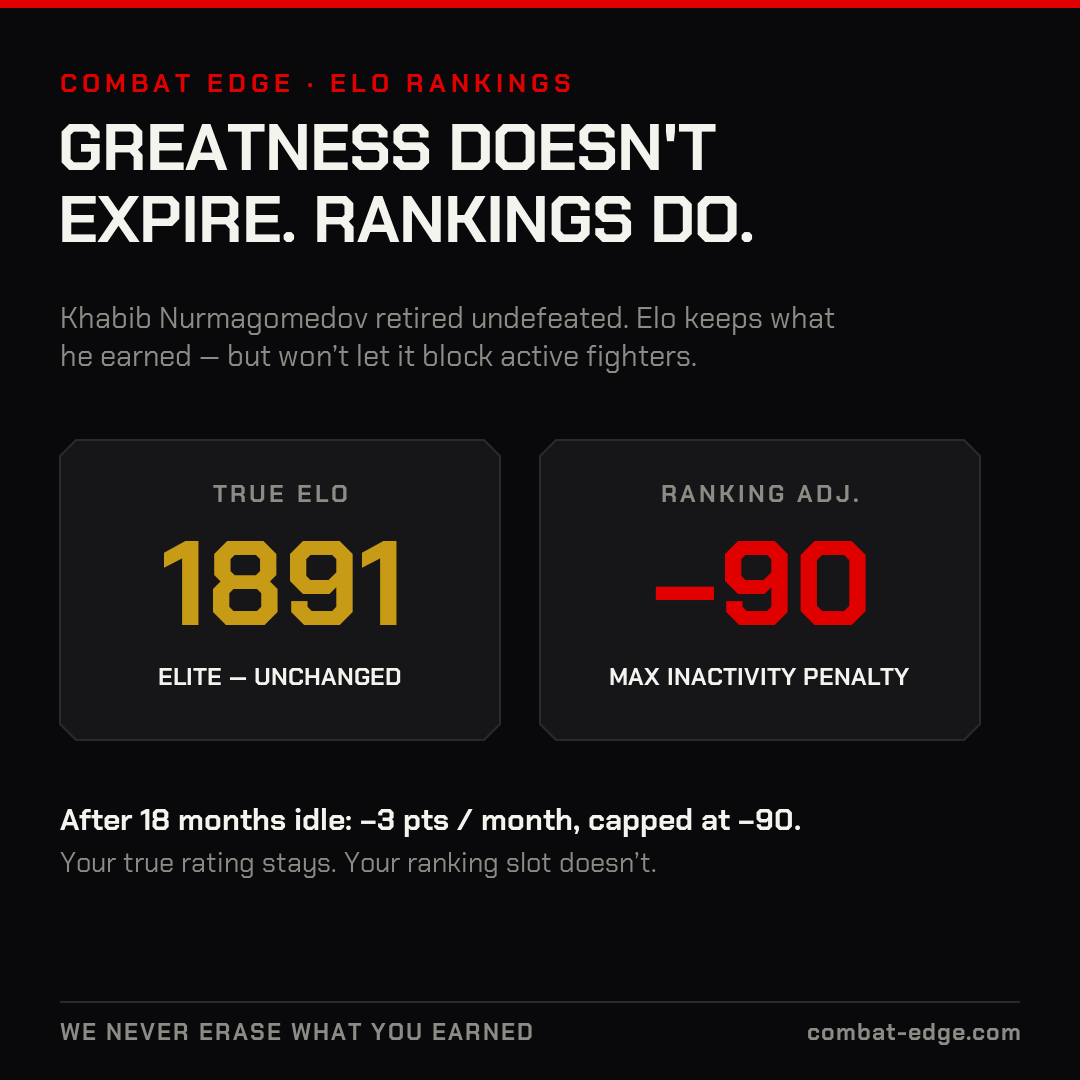
Combat Edge splits the difference in a way that's almost obvious once you see it. Your true Elo — what you earned in the cage — never changes. But your ranking position can carry an inactivity adjustment: after 18 months away, the board deducts 3 points per inactive month, capped at 90.
Khabib Nurmagomedov is the perfect case. He retired undefeated, and his true rating still reads 1891 — unmistakably elite, exactly as he left it. But his ranking now carries the maximum −90 inactivity penalty, so he slides down the active ladder without ever being deleted from it. The system honors what he did and reflects that he isn't defending that spot anymore. Nothing earned is erased; nothing inactive is allowed to block the present.
Peak Elo finally settles the cross-era argument
Because true ratings are preserved, the system can also remember the single best version of every fighter who ever competed: their peak Elo, the highest rating they ever held.
This is the tool fans have wanted for decades. Prime Fedor Emelianenko — the consensus heavyweight GOAT of the PRIDE era — peaked at 1922. That is the exact number Islam Makhachev holds at #1 today. For the first time, 'prime Fedor versus a modern champion' isn't a bar argument that ends in someone leaving angry. It's two numbers on the same scale, generated by the same formula, decades apart.
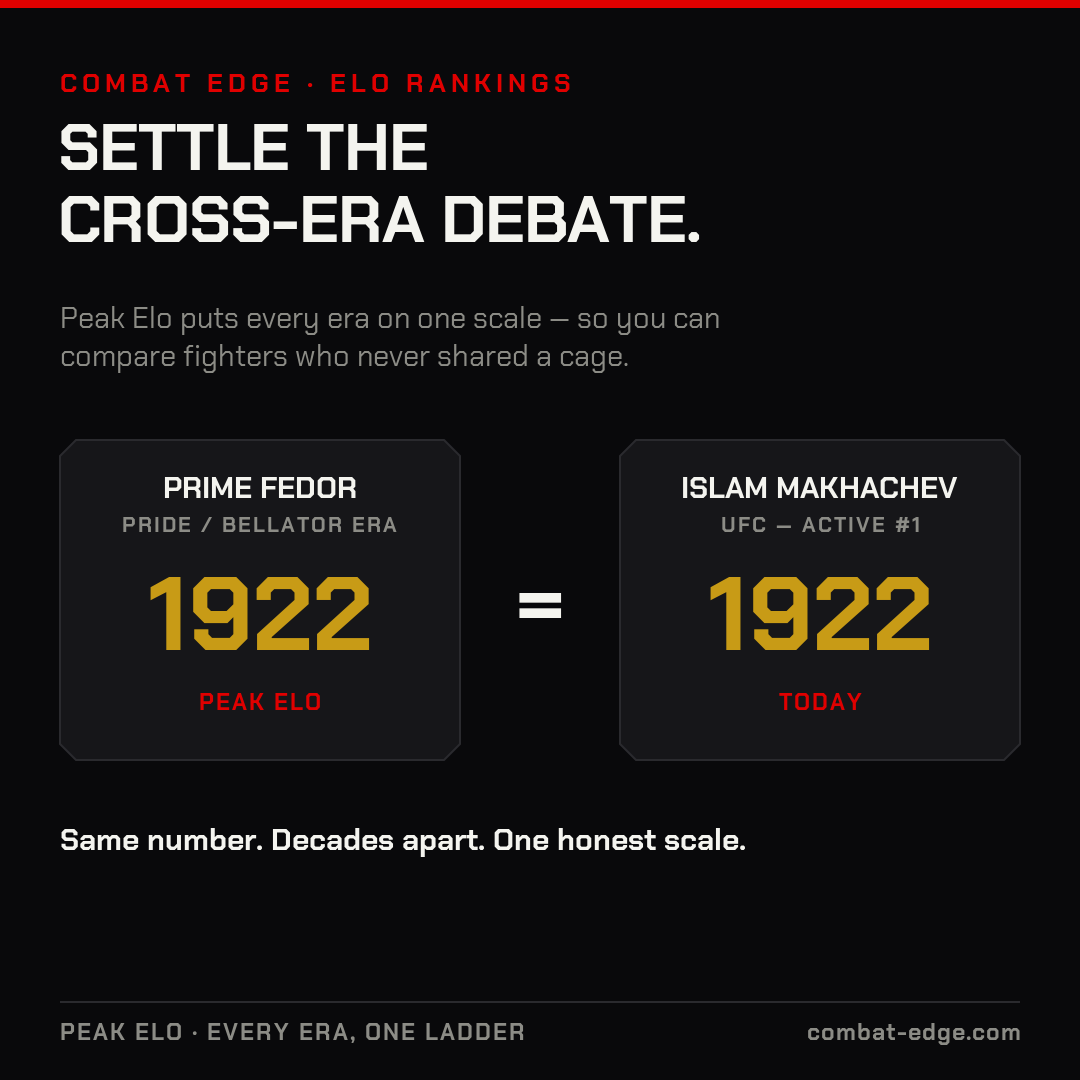
Peak Elo also exposes decline honestly. Fedor himself sits at 1860 today, well below that 1922 peak — the gap between what a fighter was and what he is, quantified. Even Jon Jones, still carrying a monster 1916, already shows a small minus 2 activity ding. The board doesn't flatter anyone and it doesn't hold grudges. It just reports.
One ladder, every promotion
The last thing a promotional ranking can never do: rank fighters who don't fight for that promotion.
Combat Edge Elo is promotion-blind. UFC, PFL, BFC, regional shows — all 4,007 fighters live on a single ladder, measured by the same math. That's how a PRIDE-and-Bellator-era Fedor and a current UFC champion can be compared directly, and how a regional standout can be measured against a ranked contender before they ever share a cage. The only thing excluded is anything that isn't pro MMA — grappling matches, boxing bouts, and exhibitions don't count toward the rating, because they aren't the sport being measured.
And the database keeps growing. Those 4,007 fighters are a foundation, not a finish line — Combat Edge is actively expanding the system, adding more fighters and more historical results over time, so the ladder gets deeper and more complete with every update.
One sport. One scale. Everybody on it.
Opinion versus measurement
Strip it all down and the difference is the exact one the UFC just drew. Human rankings tell you who's popular — a snapshot of the conversation, useful and entertaining and hopelessly tangled up in narrative.
A real ranking system tells you who's winning — against whom, how convincingly, and how recently — recalculated after every single fight, with no one's thumb on the scale. It rewards the upset over the safe win. It refuses to erase history while refusing to let it block the present. It puts every era and every promotion on one honest scale.
That's not another opinion to argue with. It's a measurement — exactly what the UFC says it now wants. The good news is nobody has to wait for it to launch. The system they're describing is already live.
See where your favorite fighter actually ranks on the Combat Edge Elo rankings.