
Section 1
1Executive summary
A Decentralized Combat Organization (DCO) is an MMA promotion with no promoter in the middle. Fighters book their own fights, a public rating sets the card and the pay, and every dollar moves on a public ledger. The people who fight own the organization they build.
The model has six moving parts.
Fighters make the fights. Any registered fighter can challenge another in their weight class. If the matchup is competitive by rating, both sign a standard one-bout contract. There is no purse to negotiate, because pay is a formula. There is no exclusivity.
Combat Edge ELO sets the card. Bouts are ordered by the average rating of the two fighters. Highest average is the main event. Lowest opens the prelims. Nobody is buried or pushed for marketing reasons.
The books are public. Each event starts with gross revenue. Venue, production, labor, commission fees and fighter floors come off as itemized cost lines on a public ledger. What is left is profit.
Profit is split by a voted formula. Token holders set the split between the fighter pool, a gym pool, holder distributions and the treasury. The fighter pool is divided by each fighter's pre-fight ELO, frozen when the card locks. Beat better fighters, raise your ELO, and both your cash and your token pay rise. A small gym pool pays the teams that trained the fighters on the card.
The token pays its holders. Fighters choose how much of their pool pay to take in cash and how much in tokens. Tokens receive a share of every event's profit, so a fighter who holds keeps earning after the last fight. That is the retirement plan MMA has never had.
Distribution is open. The model does not depend on how fans watch. A free, sponsor-funded stream, a ticketed main card, a membership or a media-rights deal all book revenue to the same public ledger and pass through the same split, so not every main card needs to be pay-per-view. The model fits decentralized distribution especially well. In the flagship's reference design the prelims stream free on YouTube and Twitch, any approved creator can co-stream them with their own commentary and keep what their channel earns, and a ticketed main card is sold once, for $20, through one paywall with many storefronts: the DCO's page, each fighter's link and each creator's branded page. Every sale is attributed on the public ledger.
The DCO is an open protocol. Any licensed operator can stage events on it. Combat Edge supplies the rating and the software, and launches the first flagship organization to prove the model end to end. It is looking for the partners to do that with (Section 14).
The timing is deliberate. The UFC kept 57% of its $1.50 billion 2025 revenue as adjusted EBITDA. It paid $375 million to settle claims that it suppressed fighter pay. Congress is now close to letting the same promoter-owns-everything structure into boxing. This paper describes the opposite structure and how to build it.
It is also more than a paper. The rules for fighters, cards, pay, the ledger and governance already run in working software, DCO OS, on demo data (Section 15). Operator bidding and on-chain settlement are the parts still on paper. The worked example in Section 9 is reproduced by that software to the dollar, and every figure a reader sees in this paper's screenshots comes out of the same settlement engine a real event would use.
Section 2
2The problem
MMA's problem is not the fights. It is that one company controls the contracts, the rankings, the titles and the books, and the fighters own none of it.
One buyer sets the price. TKO reported UFC revenue of $1.502 billion for 2025 and adjusted EBITDA of $851 million, a 57% margin. Expert reports filed in the UFC antitrust case put the fighters' share of event revenue at 19 to 20% every year from 2011 to 2017. Analyses of TKO's SEC filings since then put it lower, at about 16% in 2022 and 13 to 15% in 2023. NBA, NFL and NHL players receive about half of league revenue through collective bargaining. MMA fighters have no union, no draft and no floor.
The courts have already looked at this. In Le v. Zuffa, a class of about 1,100 fighters won a $375 million settlement, given final approval on February 6, 2025. The claim was that the UFC used exclusive contracts and market power to suppress pay. In certifying the class, Judge Richard Boulware wrote: "Due to this anticompetitive, coercive conduct, fighters were trapped by Zuffa's exclusionary contracts and their restrictive terms, creating a situation in which Zuffa had unfettered power and opportunity to suppress fighters' compensation." A second class action, Johnson v. Zuffa, covers fighters from July 2017 onward and is still in court. A third, Cirkunovs v. Zuffa, was filed in May 2025.
The law that protects boxers never covered MMA. The Muhammad Ali Boxing Reform Act of 2000 separates promoters from rankings and titles, limits coercive contracts, and forces promoters to disclose what they earn from a bout. None of it applies to MMA. That gap is why a single MMA promoter can rank its own fighters, award its own belts and keep its finances private.
Congress is now moving boxing toward the MMA model, not the reverse. The Muhammad Ali American Boxing Revival Act (H.R. 4624) passed the House by voice vote on March 24, 2026. Its Senate companion, S. 5188, cleared the Senate Commerce Committee on September 16, 2026 and heads to the full Senate. The bill adds real floors, $200 per scheduled round and $50,000 of medical coverage for bout injuries. It also creates Unified Boxing Organizations (UBOs) that may promote fights, set rankings and crown champions under one roof. TKO and Dana White back it. Critics including Oscar De La Hoya, Bob Arum and Eddie Hearn, and Rep. Joe Courtney in the House, say it imports the UFC structure into boxing. One analysis notes six-year UBO contracts with mandatory arbitration, which would replace the private right to sue that UFC fighters used to win their settlement.
Five failures follow from that structure, and each maps to a part of the DCO.
| Failure today | DCO answer |
|---|---|
| The promoter decides who fights whom, and can freeze out a fighter | Fighters challenge each other directly (Section 5) |
| The promoter controls rankings and titles | Independent, promotion-blind Combat Edge ELO (Section 3) |
| Purses are private and negotiated one by one | One public pay formula for everyone (Section 9) |
| Finances are closed | Every revenue and cost line on a public ledger (Section 7) |
| Fighters leave with no equity and no pension | A revenue-paying token earned by fighting (Section 10) |
Section 3
3The Combat Edge ELO
Combat Edge ELO is the DCO's single source of truth for who is good. It is not perfect. It is the closest thing the sport has to a fair ranking, because no person votes on it.
How it works. Every fighter enters at 1500. Win and you take points from your opponent. Lose and you hand them over. Fights are processed in the order they happened, and a win is worth what the opponent was rated on that night. Merab Dvalishvili's decision over then-champion Sean O'Malley at UFC 306 paid +17. The same kind of decision over Cory Sandhagen paid +10. Finishes move ratings more than decisions, but method is a modifier, not the engine.
Why it is fair enough to pay people by.
- It is merit only. You climb by beating higher-rated fighters. A padded record barely moves the number.
- It is promotion-blind. The ladder already rates 4,007 professional fighters across 14 divisions, from the UFC to regional shows. A fighter arrives at the DCO with a rating on day one. That solves the cold start that kills most new rating systems.
- It handles inactivity without erasing history. A fighter's true ELO never decays. The ranking position loses 3 points per month after 18 months away, capped at 90. Khabib Nurmagomedov's true rating still reads 1891, but he no longer blocks the active ladder.
- It shows its work. Every point swing of every fight is published.
Known limits. ELO measures results, not drawing power. A 1700 fighter with a huge following sells more tickets than a quiet 1850. ELO is also noisy for fighters with only a few bouts, and cross-division comparisons are rough. Sections 9 and 16 come back to these.
Its role in the protocol. The rating does four jobs.
| Job | Rule |
|---|---|
| Validates a challenge | The matchup must fall inside a win-probability band |
| Orders the card | Bouts sort by the average ELO of the two fighters |
| Sets pay | Each fighter's share of the pool is a function of pre-fight ELO |
| Names champions | The top-ranked active fighter in each division holds the title |
Keeping it honest once money rides on it. Combat Edge publishes each post-event rating update as a signed record. The methodology is public. Any change to it takes effect only after a notice period and never rewrites past ratings. The rating stays independent of every organization that uses it, including Combat Edge's own flagship. The DCO software imports ratings read-only. It has no way to edit one.
In June 2026 the UFC and Meta launched the Meta UFC Rankings, a data-driven system that replaces the UFC's media-panel rankings. It is a better method than a media vote. It is still a rating owned by the promoter that also signs the checks, which is the conflict the original Ali Act was written to stop. The DCO keeps the two apart by design.
Section 4
4Protocol overview
The DCO replaces the promoter with a set of public rules. Everything a promoter decides in private today becomes either a formula, a vote or a competitive bid.
Decentralized does not mean unregulated. Every bout is sanctioned by the local commission, and every event has a licensed promoter of record. The difference is that the operator is a contractor working for a fee, not an owner keeping the margin.
| Actor | What they do | How they are paid |
|---|---|---|
| Fighters | Challenge, accept, fight, vote | Cash floor plus an ELO-weighted share of the pool, in cash and tokens. 10% commission on tickets and main-card streams sold through their own link. 100% of their personal sponsorship and gear auctions |
| Gyms | Train the fighters, confirm their rosters, keep fighters active and improving | A share of the gym pool for every fighter they put on a card, in cash and tokens |
| Fans | Follow fighters, tell them which fights they want, read every event's books, buy tickets and streams | Nothing is paid on results. Fans who buy tokens become holders |
| Creators | Co-stream the free windows with their own commentary; when a main card is ticketed, sell it through their own storefront with their commentary on the clean feed | Everything their channel earns on a co-stream. 10% of list on every main-card ticket they sell, plus any markup they set (Section 8) |
| Token holders | Fund the organization, vote on the split and budgets | A pro-rata share of every event's profit |
| Event operators | Licensed promoters of record who stage the event: venue, production, staff, commission filings | A fixed fee, bid in the open and posted as a cost line |
| Combat Edge | Publishes the ELO and maintains the software | A flat protocol fee on gross revenue, posted as a cost line |
| Athletic commissions | Sanction events, approve matchups, license fighters and officials | Statutory fees, posted as a cost line |
Protocol and flagship. The protocol is open: the contracts, the pay formula and the ledger format are public, and any licensed operator can launch an organization on them with its own token. Combat Edge launches the first one, the flagship DCO, to prove the model with real fighters and real revenue. The rating is the shared layer. A fighter's ELO means the same thing in every organization that adopts the protocol.
Section 5
5Matchmaking: fighters book their own fights
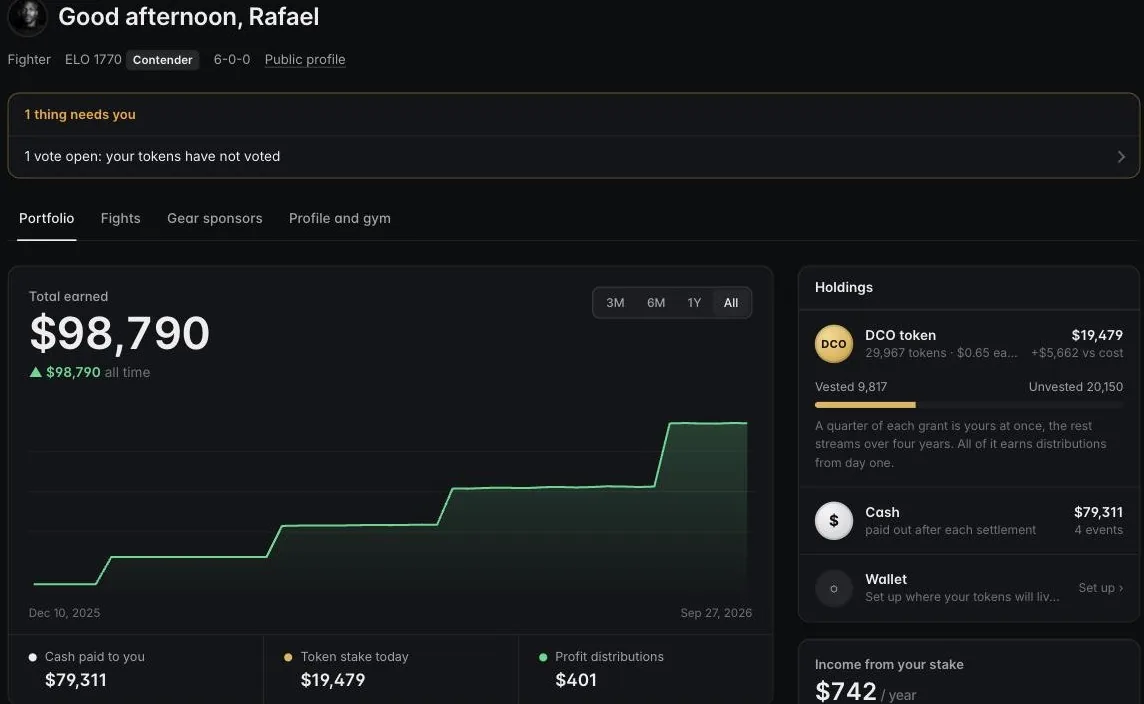
In the DCO a fight exists when two fighters sign it. No matchmaker can shelve a fighter, feed a prospect or withhold a title shot.
Registration. A fighter joins once: identity check, professional license, current medicals and a wallet. They name the gym that trains them, and the gym confirms it. Their Combat Edge ELO is already on the ladder.
The challenge. A fighter issues a challenge to a named opponent, or posts an open challenge to anyone in range. The challenge states the weight class, the rounds, a date window of up to 60 days and a region. Before anyone signs, the software shows both fighters the projected pay at current ELO and what a win or a loss would do to each rating.
The ELO band. A challenge is valid only if the favorite's ELO win probability is 64% or lower. On a standard 400-point ELO scale that is a gap of about 100 points. The band is deliberately tight. It forces competitive matchups and keeps a top fighter from padding their pay against someone clearly beneath them. It blocks squash matches and protects prospects from being thrown in too deep. Governance can tune the number. The commission still has final approval of every matchup.
Open-challenge nights. A fighter can post "anyone in my band, in this window." Fighters inside the band put their names in for seven days. When the week ends, the highest-rated taker who can still sign gets the fight, and both signatures go on the contract. The poster can also close early and award it to the best taker so far. It is good content, and it fills cards fast.

The contract. Acceptance creates a one-bout contract signed by both fighters. It holds no purse figure, because pay comes from the formula in Section 9. Its terms are standard and public.
| Term | Rule |
|---|---|
| Length | One bout. No exclusivity, no option years, no champion's clause, no automatic extension |
| Date and place | Any event inside the signed window and region. Outside it needs a new agreement. Rest and medical rules are checked again on the real event date |
| Rounds | Three or five, as signed. A bout that lands in the main event or is a title fight is five rounds |
| Pay | Cash floor plus ELO-weighted pool share, using the ELO published before the card locks |
| Weight miss | 20% of the offender's pool pay moves to the opponent automatically. The scale reading decides, a commission official is named, and one re-weigh is allowed |
| Withdrawal | A fighter from the event's standby list steps in. They must pass the same band, division, medical and rest rules, and they earn a $2,500 short-notice premium, posted as a cost line. If nobody valid is available, the bout is cancelled and whoever was ready to fight is paid the cash floor |
| Medical suspension | Set by the commission. The contract reads the result and blocks new challenges until the fighter is cleared |
| Disputes | A named arbitration body. The fighter keeps the right to go to court |
The one-bout, non-exclusive contract is the point. The antitrust cases against the UFC turned on long exclusive contracts that locked fighters in. The DCO has nothing to lock. Fighters stay because the pay and the ownership are better, or they leave.
The duty to defend. Freedom to choose fights creates a risk: a top fighter sits on a high rating and ducks contenders. The rule mirrors how Combat Edge already treats inactivity. A fighter ranked in the divisional top five who declines valid challenges from three different top-ten opponents within 12 months takes a ranking deduction, starting at 30 points and growing by 15 with each further refusal, up to 90. Ignoring a challenge for 14 days counts as declining it. True ELO is untouched, so the rating stays pure. The deduction moves the fighter down the title order and lowers the ELO used for pay until they sign a fight. Injury and medical suspension pause the clock.
Champions. The title belongs to the top-ranked active fighter in each division. It changes hands by math, in public. A champion who stops defending loses the top spot without anyone stripping a belt.
From signed bouts to a card. Signed bouts sit in an open pool with their date windows and regions. Event operators bid to stage an event (in the software today the operator creates the event directly; open bidding comes later, once several operators are on the protocol). The operator fills the card from the pool, with any bout whose window and region fit the event. If too few fights are signed for a date, the software suggests band-valid matchups to fighters who have marked themselves available. It suggests. It never assigns. Nothing exists until one of the two fighters posts the call-out and the other signs.
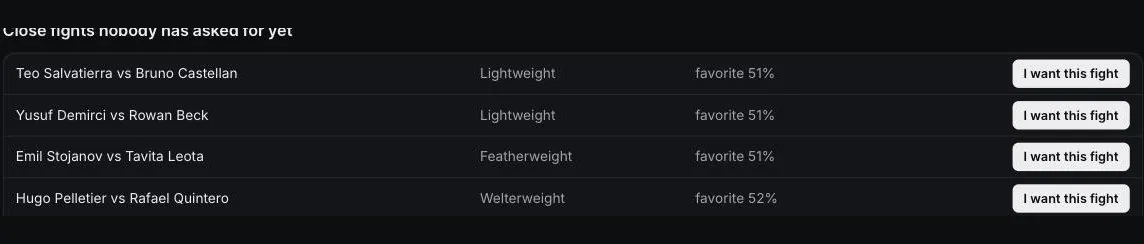
Fan demand. Fans, gyms and other fighters can back any fight the rules would allow. Fighters see that demand next to each possible opponent when they choose who to call out, and it ranks the suggestions. It is a voice only: no money is attached and nothing is paid on the result, so it stays clear of the betting line in Section 12.
Section 6
6Card construction
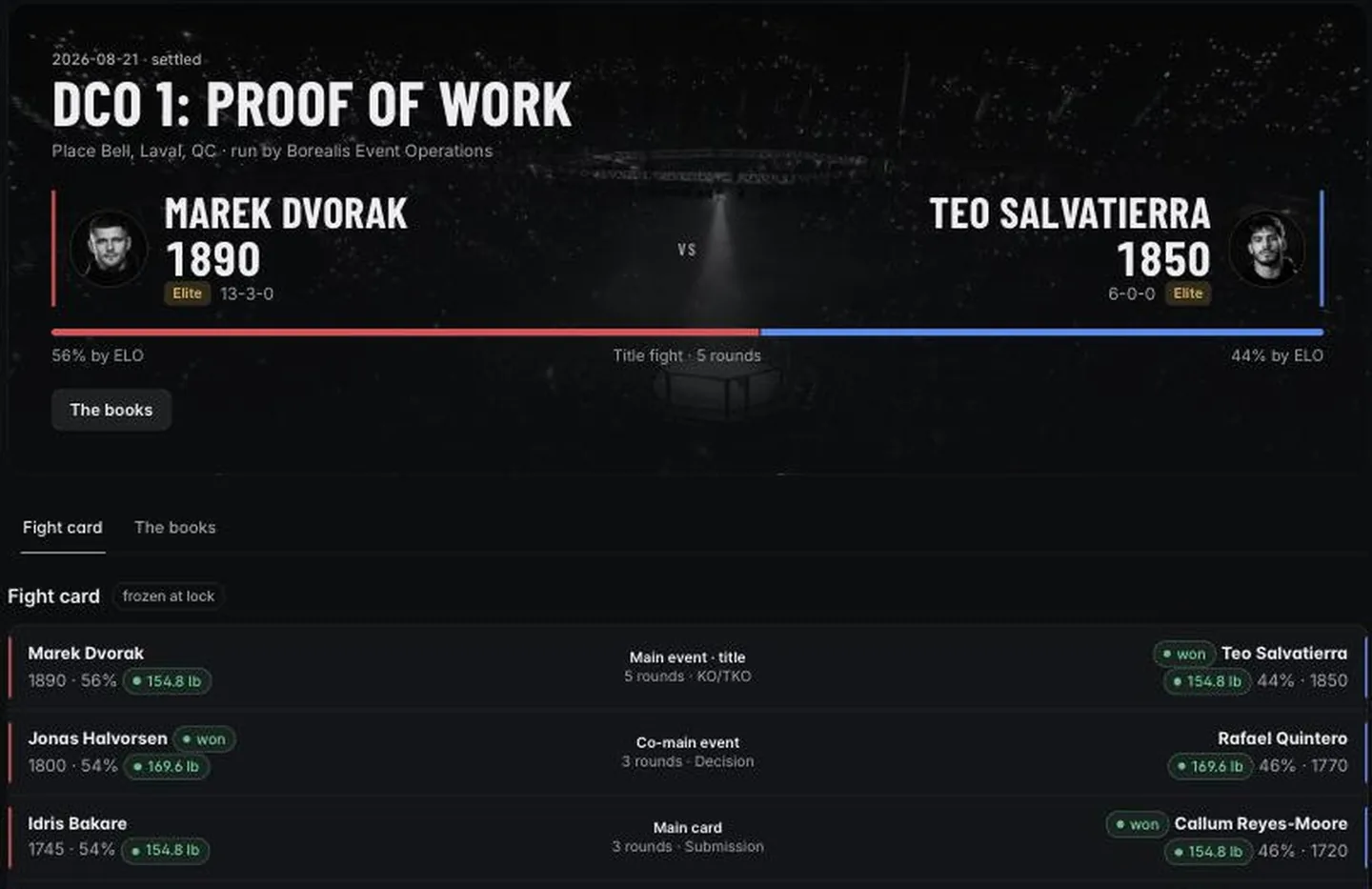
Bout order is a sort, not a decision. The fight with the highest average ELO is the main event and the lowest opens the prelims.
The sample 12-bout card below is used for the pay example in Section 9.
| Slot | Fighter A ELO | Fighter B ELO | Average | Favorite's win probability |
|---|---|---|---|---|
| Main event | 1890 | 1850 | 1870 | 56% |
| Co-main | 1800 | 1770 | 1785 | 54% |
| Main card | 1745 | 1720 | 1732.5 | 54% |
| Main card | 1700 | 1690 | 1695 | 51% |
| Main card | 1660 | 1630 | 1645 | 54% |
| Prelim | 1615 | 1600 | 1607.5 | 52% |
| Prelim | 1580 | 1560 | 1570 | 53% |
| Prelim | 1545 | 1530 | 1537.5 | 52% |
| Prelim | 1510 | 1500 | 1505 | 51% |
| Early prelim | 1480 | 1465 | 1472.5 | 52% |
| Early prelim | 1450 | 1430 | 1440 | 53% |
| Opener | 1410 | 1400 | 1405 | 51% |
A few rules keep the sort clean.
- Frozen ratings. Order and pay use the last ELO update published before the card locks, 14 days out. Gym affiliations, cash-or-token elections and the governance rules freeze at the same moment. Nothing that happens after the lock changes the math.
- Title fights. A bout between the top two active fighters in a division is a title fight. It will almost always top the sort anyway. When two title fights share a card, the higher average goes last.
- Ties. Equal averages are broken by the higher single ELO in the bout.
- Late replacements. A replacement re-sorts the bout by its new average. Pay follows the new position.
- Five rounds. Main events and title fights are five rounds. Everything else is three unless the fighters signed for five.
Average ELO is a better ordering rule than it first looks. It rewards two good fighters meeting each other, not one star facing a filler opponent. An 1890 against a 1700 averages 1795 and would sit below two 1800s. The band in Section 5 already blocks the worst mismatches, and the sort discourages the rest.
Section 7
7The event revenue waterfall
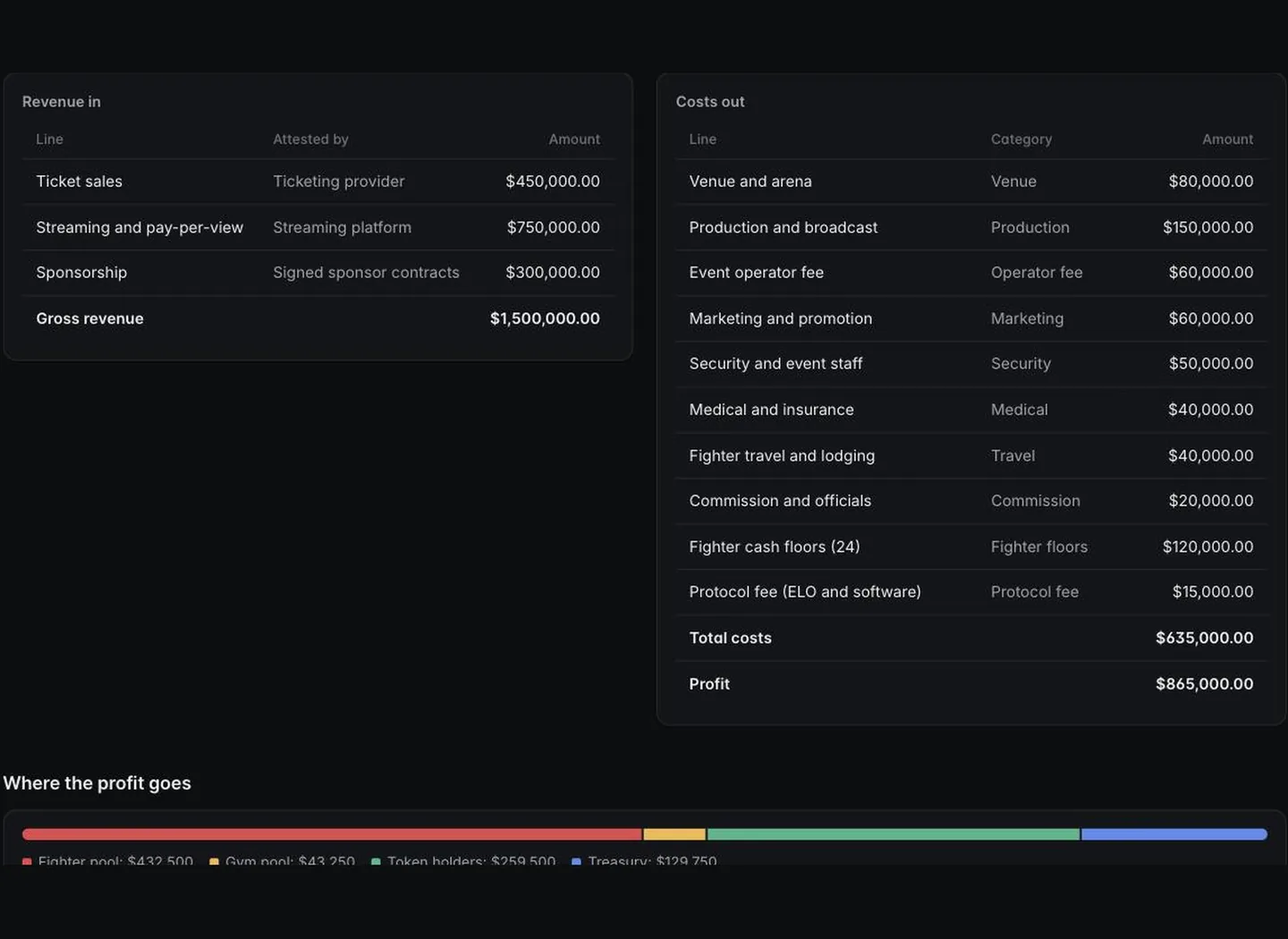
Every event publishes one ledger: what came in, what it cost line by line, and where the profit went. Anyone can read it.
Revenue in. Gate, media rights, main-card ticket sales where a card is sold that way (Section 8), sponsorship and merchandise. Each figure is attested by the provider that collected it and reconciled by an independent auditor before settlement. If any line changes after the auditor approves, the approval is void and the books go back for review. Betting revenue is out of scope (Section 12).
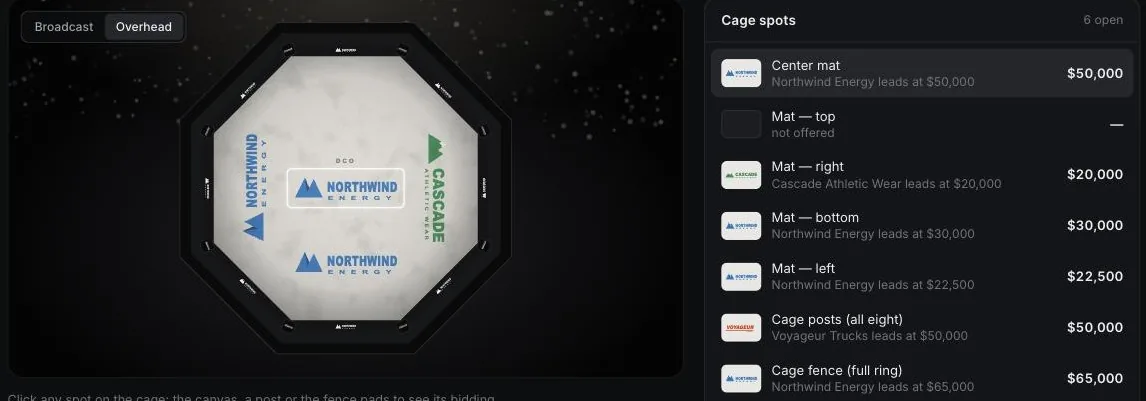
Sponsorship, sold in the open. Sponsorship is not negotiated behind closed doors. Each event spot is auctioned in an open ascending bid to verified sponsors: the canvas, each side of the cage, the posts and the fence, the walkout tunnel, the round cards, and presenting rights for the main card or the prelims. The winning bid is folded into the event's gross before the split. A bigger sponsor check therefore lifts every fighter's purse, not the promoter's cut. Because the proceeds enter the pool automatically, an operator can never enter or edit them by hand. The highest bid at the close wins, and a tie goes to whoever reached the price first. The promotion can accept a standing bid early or block a brand it will not carry.
Costs out, itemized. The sample event grosses $1,500,000 with the 24 fighters from Section 6.
| Cost line | Amount | Who sets it |
|---|---|---|
| Venue and arena | $80,000 | Operator bid |
| Production and broadcast | $150,000 | Operator bid |
| Event operator fee (labor to run the show) | $60,000 | Operator bid, approved budget |
| Marketing and promotion | $60,000 | Approved budget |
| Security and event staff | $50,000 | Operator bid |
| Medical and insurance | $40,000 | Commission rules plus protocol minimums |
| Fighter travel and lodging | $40,000 | Protocol standard |
| Commission and officials | $20,000 | Statute |
| Fighter cash floors (24 × $5,000) | $120,000 | Governance |
| Protocol fee (1% of gross: ELO and software) | $15,000 | Governance |
| Total costs | $635,000 |
Profit is $1,500,000 minus $635,000, which is $865,000.
Profit split. The opening split is a straw man. Token holders can change it by vote (Section 11).
| Layer | Share | Amount | Purpose |
|---|---|---|---|
| Fighter pool | 50% | $432,500 | Divided among the card's fighters by ELO (Section 9) |
| Gym pool | 5% | $43,250 | Paid to the gyms of the fighters on the card (Section 9) |
| Holder distribution | 30% | $259,500 | Paid pro rata to every token, in stablecoin |
| Treasury | 15% | $129,750 | Growth, loss reserve, fighter health fund |
That is 37% of gross revenue: about twice the 19–20% the UFC paid in 2011–2017, and more than twice its recent level. Every figure behind it is public.
Four design choices matter here.
- Floors are a cost, not a share. A fighter is paid the floor even if the event loses money. The treasury's loss reserve covers a shortfall. Token holders sit closest to the risk, as owners should.
- Operators compete on cost. Operators bid for events against a budget that holders approved. A cheaper, better operator wins more events. No one keeps an unexplained margin.
- Organization-level revenue uses the same split. A multi-event media deal or a league sponsor is booked to the treasury, then released in equal parts into the gross of each event it covers, in date order. Each part goes through the same waterfall as a ticket. Once an event takes a part, that part never moves. If an event's card falls through entirely, its part passes to the next event.
- Settlement is final. A settled event cannot be edited. A correction is posted in the next period, in public.
What is actually on-chain. Payments settle in a regulated stablecoin on a low-fee Ethereum layer 2. The ledger holds attested totals, cost lines, the split and every payout. Invoices and contracts sit off-chain with their hashes on-chain, so the auditor and any holder can check that the documents match the numbers.
Section 8
8Distribution: the creator-native fight league
The model is agnostic to distribution. Any way of showing the fights that produces attested revenue runs through the same ledger and the same split, and not every main card needs to be pay-per-view. It fits decentralized distribution best: free windows that creators carry, and a main card that many storefronts can sell, with every sale attributed on the public ledger.
Agnostic by design. The waterfall in Section 7 starts from gross revenue and does not ask where it came from. How an event reaches its audience is a commercial choice made card by card, not a rule of the protocol. A league on the protocol can stream a main card free and live on sponsorship, sell it as a ticket, put it behind a membership or license it to a broadcaster. Each choice books a different revenue line. The split, the pay formula and the public ledger are the same in all four.
| Window | How the money comes in | What the ledger books |
|---|---|---|
| Free stream | Sponsorship auctions, and a wider audience for the gate. Platform ad revenue where there is any | Sponsor bids at the closing price, and ad revenue as the platform reports it |
| Ticketed main card | A one-event ticket, sold by the DCO, the fighters and approved creators | Each sale at list price, attributed to its storefront |
| Membership | A recurring pass on the DCO's own channel or on a platform | Organization-level revenue, released through the events it covers (Section 7) |
| Media-rights deal | A fee from a broadcaster or platform for one card or a season | Booked to the treasury and released in equal parts through each covered event (Section 7) |
Why decentralized distribution fits. The rest of the DCO removes a gatekeeper and publishes the numbers. Distribution can work the same way. When creators and fighters carry and sell the feed, there is no single broadcaster to depend on, the people who bring an audience are paid for it, and every sale they make is attributed on the ledger like any other revenue line. A rights deal with one buyer is still compatible with the model. It is the least decentralized option, and a new league rarely has the leverage to get a good one.
Why the flagship does not start with a rights deal. A new promotion has no leverage with a broadcaster, and the market it would sell into has just been reset. The UFC ended pay-per-view in the US in 2026: every numbered card is now included in Paramount+ at $8.99 a month under a $7.7 billion, seven-year deal. In Canada, UFC pay-per-view still costs C$69.99 this year and moves into Paramount+ Canada in January 2027. A fan comparing a new league's card to the UFC will compare it to a monthly subscription, not to a C$70 event. Meanwhile, the combat promotions growing fastest without a rights fee stream free: Power Slap left a Rumble deal worth about $30 million a year for free YouTube plus sponsorship, and Dirty Boxing Championship, co-founded by a fighter, streams full cards free on YouTube. Creator distribution has shown its reach: Ibai's La Velada VI peaked at about 7.7 million viewers across YouTube, Twitch and TikTok in July 2026, and one creator's "Watch With" stream of the NFL's first YouTube game drew 1.4 million.
The flagship's reference design is to own its rights, keep them global and clean, and let distribution grow from the bottom up. Four parts make it work.
1. The world feed. Production delivers one clean feed: cage cameras, natural sound, the ring announcer and the referee's microphone, graphics for the ELO and the card, and no commentary. The DCO owns it globally and outright, which is what a platform's rights-management system requires before it will protect a live stream. That has one practical consequence: walkout music must be commissioned or licensed for worldwide streaming, because third-party music in the feed can disqualify it from YouTube's live Content ID. A house commentary team is produced as a separate audio track, not burned into the picture. Fans who want the fight with no talking already exist: UFC's "UFC Muted" series of full fights without commentary has built a following on YouTube, and Amazon has offered stadium-sound-only Premier League streams since 2019. No live MMA event has been sold that way before.
2. Free prelims, everywhere. The prelims stream free on the DCO's own YouTube channel, simulcast on Twitch, with ads and the auctioned prelim sponsorship (Section 7) in the picture. Any creator the DCO approves can co-stream them with their own commentary and camera. The license is short and public, modeled on the terms rights holders already use for co-streaming, such as the Esports World Cup's:
- Show the whole picture. No cropping or covering the sponsor placements that the event sold in its auctions.
- No betting, casino or competing-promotion sponsors on the co-stream. The creator's other sponsors are allowed.
- Free windows only. A ticketed main card is never rebroadcast outside the paywall.
- The creator keeps everything their channel earns on the co-stream: ads, subscriptions, tips and memberships.
- The DCO allowlists approved channels so its rights claims do not hit them, and can revoke approval for a breach.
The prelims are marketing. Their direct ad revenue is small and the model counts it as zero. What they buy is reach: the audience that prices the sponsorship auctions and the audience the main card sells to.
3. A ticketed main card: one paywall, many storefronts. Not every main card has to be sold. A card can go out free on the same terms as the prelims when sponsorship and the gate carry it. When a main card is ticketed, it is sold once, through one ticket system that the DCO runs: a white-label pay-per-view platform at launch, or a platform's own pay-per-view tool once one is open to the DCO. On top of it, every approved creator and every fighter on the card gets a storefront: a page and link of their own that sells the same ticket.
| Storefront | Price | What the buyer gets | Who earns what on a ticket |
|---|---|---|---|
| DCO page | $20 | The clean feed, with the house commentary track as an option | The full $20 goes into the event's gross |
| Fighter link | $20 | The same ticket | The fighter earns 10% ($2), the same commission as on gate tickets (Section 9) |
| Creator storefront | $20–$30 | The clean feed with the creator's commentary as the default audio, and their camera in a corner if they want one | The creator earns the same 10% of list ($2), plus any markup they set, up to $10, net of the platform fee on the markup |
A creator who sells at $25 earns $6.50 a ticket: $2 of commission and $4.50 of markup after the platform fee. Nobody can sell below list, so a creator's storefront only wins buyers by being worth more than the plain feed. The DCO books the same $20 into the event's gross whichever storefront made the sale. The platform fee and the commissions are itemized cost lines on the ledger.
Why one paywall, not resellers. The first version of this idea let creators take the feed and sell it themselves. It fails on four counts, and one ticket system with many storefronts fixes all four.
- Platforms cannot do it. None of YouTube, Twitch or Kick lets an ordinary channel sell a one-event ticket. YouTube's pay-per-view is limited to a small number of pre-selected channels, and tickets can only be bought in the US. Twitch and Kick have no ticketed streams at all.
- Piracy. Every reseller holding a clean feed is another place it can leak. One ticket system can put a forensic watermark on every viewer's stream and trace a leak in minutes. Vendors now mark the distributor and the viewer separately.
- The ledger. Section 7 requires every revenue line to be attested by the provider that collected it. One ticket system is one attestation. Fifty resellers would be fifty.
- Getting paid. A promoter that lets others collect its money carries their credit risk. AEW is suing TrillerTV for about $5 million in unpaid pay-per-view payments. With one paywall, the DCO collects and pays commissions out, never the reverse.
4. Creators and fighters on the ledger. Storefronts are a new module in DCO OS. A creator applies, the DCO approves them against the co-stream license, and the software issues storefront and prelim-allowlist credentials. After the event, the ticket system's attested sales roll into the ledger by storefront. Commissions and markups are paid in the same settlement run as the fighters, as public cost lines, and each creator's sales are public like everything else. If the token launches (Section 10), a slice of the Ecosystem pool is reserved for grants to the creators who sell the most, vesting on the same four-year schedule as fighter grants. That gives the league's distributors a stake in the league, the way the Kings League gives its streamers teams. Those grants are subject to the same counsel sign-off as the rest of the token.
What the numbers can realistically be
The scenarios below take a ticketed main card, the harder case to forecast. Public buy rates for small promotions are almost nonexistent. The one hard benchmark is PFL's Ngannou card in October 2024: $49.99, and about 10,000 North American buys by a trade report. A new league at $20 should plan on thousands of buys, not hundreds of thousands. The table runs a 10-bout launch card (20 fighters) through the token model's cost assumptions, where break-even is about $319,000 of gross.
| Per event | Conservative | Base | Breakout |
|---|---|---|---|
| Main-card buys | 1,500 | 5,000 | 15,000 |
| Pay-per-view gross at $20 | $30,000 | $100,000 | $300,000 |
| Gate | $99,000 | $162,500 | $300,000 |
| Sponsorship auctions | $60,000 | $110,000 | $200,000 |
| Gross | $189,000 | $372,500 | $800,000 |
| Pay-per-view share of gross | 16% | 27% | 38% |
| Profit | −$89,590 | $37,025 | $332,000 |
Gate assumes 1,800, 2,500 and 4,000 seats at $55, $65 and $75. Platform fees are taken at 10% plus $0.40 a purchase, a published white-label rate. With 45% of buys through fighter and creator links, the DCO nets about $16.70 of each $20 ticket after fees and commissions. Costs follow the token model: $120,000 fixed, 30% variable, 1% protocol fee, $5,000 floors. Losses are covered by the treasury's loss reserve, so floors are paid in every column.
Three conclusions follow. First, pay-per-view does not carry the first year; gate and sponsorship do, and the free prelims exist to grow the audience that sponsors pay for. Second, the model only reaches its breakout column if creators move buyers. That is testable at the first ticketed card, because every sale is attributed by storefront. Third, a free main card is a real option. In the conservative column it gives up $30,000 of gross, before fees and commissions, and needs the wider audience to return that through sponsorship and the gate.
Platforms and partners
| Platform | What it can do for the DCO today | What the DCO asks for |
|---|---|---|
| YouTube | Free live prelims on the DCO channel. Creator co-streams. Members-only live streams, with creators keeping 70% of memberships (a monthly subscription, not a ticket). Pay-per-view exists but is closed to most channels and US-only. "Watch With" creator streams were built for the NFL deal and are invitation-only | The primary partner. Live Content ID with allowlisted co-streamers; a pay-per-view pilot, in Canada as well as the US; Watch With-style switching between the official stream and creator streams; promotion in the live and sports surfaces |
| Twitch (Amazon) | Free live prelims and co-streams. No ticketed streams. Subscriptions split 50/50, up to 70/30 in the Plus program | A prelims simulcast and a co-streaming program with approved streamers, featured placement, and a path into Amazon |
| Prime Video | Carries ONE Championship's live events in the US and Canada. Live events require a partner to first onboard a 24/7 linear channel (about 14 weeks), then 6–8 weeks for live events | Later: a DCO channel once there is a season of events and a library to fill it |
| White-label platforms | Ticketed live streams with storefronts, geo-blocking and watermarking. Kiswe builds white-label event pages and sends one feed to many outlets; Dacast charges 9.9% plus $0.40 a purchase | The launch paywall, whatever the platform deals turn out to be |
| Kick | Creators keep 95% of subscriptions. No ticketed streams. Owned by the founders of the Stake casino | Not a launch partner. A token-carrying league should not sit next to a casino brand (Section 12) |
The order of play. The pilot runs on a shadow event with a partner promotion (Section 14): free prelims on YouTube with a handful of Quebec and English-language creators co-streaming, the main card on a white-label paywall with storefronts. Its attributed sales, co-stream reach and leak data are what the DCO takes to YouTube. The ask is for tools, not a rights fee: pay-per-view access, live rights protection with allowlisting, and creator switching, in exchange for a first window on the DCO's official streams. Twitch gets the same prelims package with Amazon as the longer road. The flagship sells no exclusive rights at launch, because its design depends on the fight being available wherever fans already are. A league on the protocol that is offered a rights deal worth taking can take it, and the fee goes through the same public waterfall.
What can go wrong. Creator streams run behind the official stream, so results can leak into chat before a co-stream's viewers see them; the DCO keeps its own stream's delay short and asks creators not to post results. A creator can misbehave on air; approval is revocable and the license says so. Piracy will happen; per-viewer watermarking, live takedowns and, in Canada, the Federal Court's July 2026 dynamic site-blocking order give the DCO tools a new promotion rarely has. And the platforms can say no. The design does not depend on them: it runs on a white-label paywall and free YouTube from the first event.
Section 9
9Fighter compensation
A fighter's pay is a cash floor plus a share of the fighter pool set by their pre-fight ELO, frozen when the card locks. There is no show money, no win bonus and no negotiation.
Why no win bonus. The show-and-win split halves a fighter's pay on one judge's scorecard. In the DCO a win pays through the rating. It raises your ELO, and a higher ELO raises the cash and tokens you earn in every fight after it. A loss to a strong opponent costs little. Fighters are rewarded for taking hard fights, not punished for them.
The weighting problem. Splitting the pool in straight proportion to ELO does not work. Ratings on a card run from about 1400 to 1900, so a straight split pays the main-eventer only 1.4 times what the opening fighter gets. ELO is a logarithmic scale: 400 points means ten-to-one odds. Pay should read it the same way.
E is the fighter's pre-fight ELO. S is the spread, one number set by governance. At S = 400, a fighter rated 400 points higher earns ten times the pool share. A larger S flattens pay; a smaller one steepens it.
| Spread S | Main-eventer (1890) pool share | Opener (1400) pool share | Top-to-bottom ratio |
|---|---|---|---|
| Straight proportion | 4.9% | 3.6% | 1.4× |
| 800 | 8.7% | 2.1% | 4.1× |
| 600 | 10.7% | 1.6% | 6.6× |
| 400 (straw man) | 15.4% | 0.9% | 16.8× |
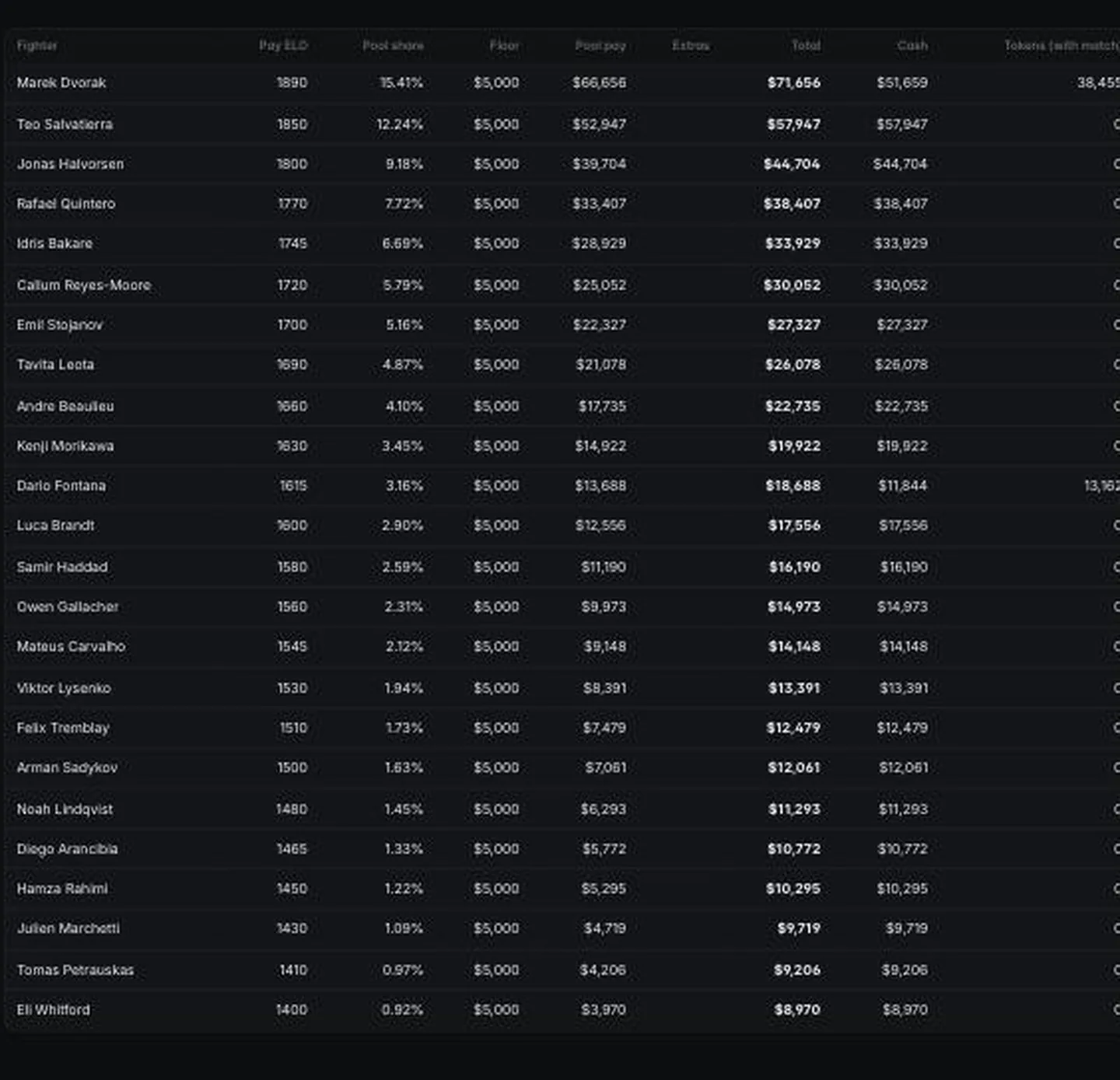
Worked example. The sample card, a $432,500 pool, S = 400 and a $5,000 floor.
| Fighter | Pre-fight ELO | Pool share | Pool pay | Total with floor |
|---|---|---|---|---|
| Main event, favorite | 1890 | 15.41% | $66,656 | $71,656 |
| Main event, underdog | 1850 | 12.24% | $52,947 | $57,947 |
| Main card | 1700 | 5.16% | $22,327 | $27,327 |
| Prelim | 1615 | 3.16% | $13,688 | $18,688 |
| Prelim | 1500 | 1.63% | $7,061 | $12,061 |
| Opener | 1400 | 0.92% | $3,970 | $8,970 |
The opener's $8,970 on a $1.5 million regional-scale event compares with typical regional purses of a few thousand dollars. The pool scales with the event. On a $15 million event with the same cost ratio, every pool figure above is ten times larger.
New fighters. A debutant starts at 1500, like every fighter on the ladder, and the rating moves with each bout from there. Pay follows the rating from the first fight. There is no separate rule for newcomers.
Cash or tokens. The floor is always cash. For the pool share, each fighter elects a mix before the card locks, from 100% cash down to 50% cash. The elected token portion buys tokens at the 30-day average price, and the Fighter Reserve adds a 25% match on top (Section 10). A fighter with rent due takes cash. A fighter who believes in the organization builds a stake. Nobody is forced to accept tokens in place of money they need.
How pay evolves. Pay tracks the rating, and the rating tracks results. A prelim fighter at 1500 who wins four straight against rising opposition might reach 1620. On the same card that moves their pool pay from about $7,000 to about $14,000, with no manager, no renegotiation and no favor from a promoter.
Drawing power. ELO pays skill, not ticket sales, so a popular fighter with a modest rating needs another way to be paid for the crowd they bring. Every fighter gets their own ticket link and earns 10% of what it sells, gate tickets and main-card streams alike, in cash, posted as a public cost line and capped by the sales the ticketing and streaming providers report. Personal sponsorship stays 100% with the fighter. The pay formula stays pure, and drawing power is paid on a number anyone can check.
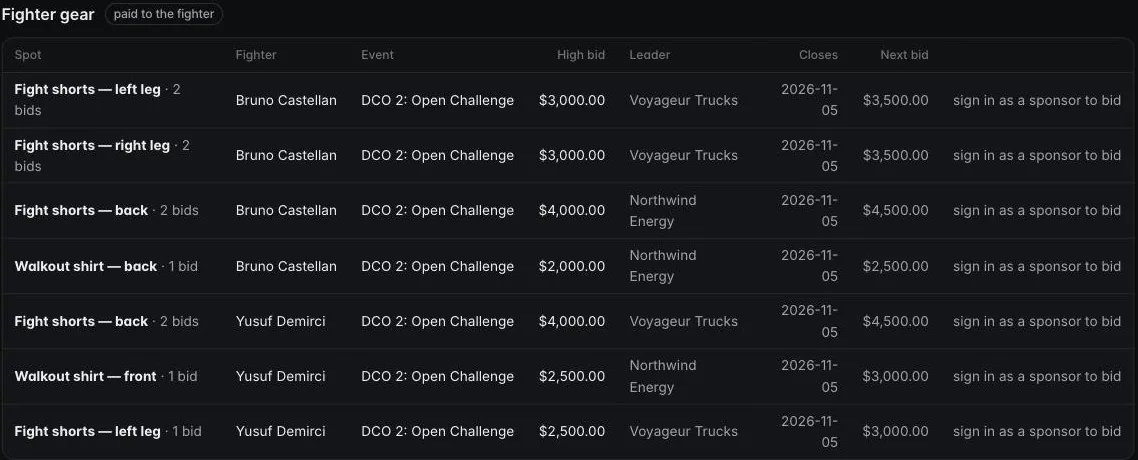
Selling your own gear. Once booked on a card, a fighter auctions the sponsor spots on their own fight shorts and walkout kit, the same open way. That money is the fighter's. It is paid to them directly, outside the event pool, minus a platform fee that token holders set and that defaults to zero. If a fighter is pulled from the card, their open gear auctions are cancelled, so no sponsor keeps bidding on a fight that will not happen.
The gym pool. MMA gyms develop fighters for years and usually see nothing when those fighters get paid, beyond a percentage they have to collect themselves. The DCO pays gyms directly from event profit. The fighter's own pay is not reduced.
Half of the gym pool is split equally per fighter on the card. The other half follows each fighter's pool share. The equal half matters: it pays the small gym that brought a debutant to the opener, where most development work happens. The weighted half rewards gyms that build contenders.
| Fighter | Equal half | Weighted half | Gym receives |
|---|---|---|---|
| Main event, favorite (1890) | $901 | $3,333 | about $4,230 |
| Prelim (1615) | $901 | $684 | about $1,590 |
| Opener (1400) | $901 | $199 | about $1,100 |
A gym with three fighters on one card collects three of these lines. Over 20 events a year it becomes steady income that grows as the team improves.
- Affiliation. A fighter names one gym, or two with a stated percentage split. Each gym must be a verified business and must confirm the fighter. The gym on record when the card locks is the gym that gets paid.
- No gym. An unaffiliated fighter's gym share goes to the fighter health fund.
- Tokens. Gyms can elect up to half of their share in tokens on the same terms as fighters, so the teams end up owning part of the organization too.
Section 10
10The token
The token is a claim on the organization's profit. Its value comes from distributions that holders can verify on the ledger, not from hype.
What a token gives you. A pro-rata share of the holder distribution from every event and from organization-level revenue, paid in stablecoin. One vote per token. Nothing else. It buys no perks, and no payout depends on who wins a fight.
Fixed supply. The straw man is 100 million tokens, never increased.
| Allocation | Share | Terms |
|---|---|---|
| Fighter Reserve | 40% | Pays the 25% match on fighter token elections. Released only as fights happen. Reserve tokens do not vote |
| Public and investor sale | 25% | Sold through compliant offerings (Section 12) to fund launch and the loss reserve |
| Treasury | 15% | Supplies the tokens fighters elect, liquidity, partnerships, fighter health fund |
| Combat Edge and builders | 15% | Four-year vesting with a one-year cliff |
| Operators and ecosystem | 5% | The 25% match on gym token elections, plus grants for operators and tooling |
Where a fighter's tokens come from. The token portion of a fighter's pool pay buys tokens from the treasury at the 30-day average price. The Fighter Reserve then adds 25% on top. Two effects follow. Fighter pay creates steady demand for the token after every event, in place of a separate buyback. And fighters gain ownership faster than any other group, without printing new supply. Holders of record are paid an event's distribution before that event's new tokens are granted, so nobody earns on tokens from the same event.
Vesting and forfeiture. A quarter of each grant is liquid at once. The rest streams over four years. All tokens earn distributions from day one, vested or not. A fighter found by a commission or arbitrator to have fixed a fight forfeits every unvested token: it returns to the Fighter Reserve and those grants stop vesting. Cash already paid, vested tokens and past distributions are not clawed back. Doping sanctions follow the commission's ruling.
The retirement plan. Illustration only, holding today's numbers flat. The organization runs 20 events a year like the sample. Distributions are 20 × $259,500, or $5.19 million a year, which is $0.052 per token. Assume the token trades at $0.65, an 8% yield. The table assumes every fight pays like the 1615 prelim slot on the sample card ($13,688 of pool pay), tokens bought at $0.65 plus the 25% match, and distributions taken as cash rather than reinvested.
| Fighter | Career | Tokens at retirement | Distributions per year | Stake value at $0.65 |
|---|---|---|---|---|
| Prelim level (1615), 30% token election | 24 fights over 8 years | about 190,000 | about $9,800 | about $123,000 |
| Same fighter, 50% token election | 24 fights over 8 years | about 316,000 | about $16,400 | about $205,000 |
That income continues for as long as the fighter holds, and it grows if the organization grows. A fighter who spent a career in the main event would hold several times more. No current promotion pays a retired fighter anything. These are not forecasts. Token prices fall as well as rise, which is why the floor and at least half of pool pay are always available in cash.
Trading. Tokens can be sold, which is what makes them worth something to a fighter who needs to exit. Because the token is a security (Section 12), transfers are limited to verified wallets and trading happens on regulated venues. That cuts speculation and keeps the price closer to what the distributions justify.
The impact link. The most active, highest-rated fighters earn the largest pool shares, so they accumulate the most tokens. Ownership ends up tracking what each fighter contributed to building the organization.
Section 11
11Governance
One token is one vote. Holders decide how the money is split and spent. They do not decide who fights, who wins, or how fighters are rated.
| Holders vote on | Threshold |
|---|---|
| The profit split: fighter pool, gym pool, holder distribution, treasury | Supermajority, 30-day delay. A fighter pool below 40% or a floor cut: 75% of voting tokens, 90 days |
| Fighter cash floors, the pay spread S and the protocol fee | Supermajority, 30-day delay |
| Annual budget and operator fee caps | Simple majority |
| Operator approval and removal | Simple majority |
| Treasury spending and the fighter health fund | Simple majority |
| Challenge band and duty-to-defend settings | Simple majority |
| Never put to a vote | Why |
|---|---|
| ELO methodology and any fighter's rating | The rating must stay independent of the money |
| Matchups, card order, results | Set by fighters, the sort and the commission |
| Medical and safety rules | Set by commissions. The protocol can only add to them |
| Payouts already earned | Settlement is final once posted |
The risk in one token, one vote. At launch, investors and fans will hold more tokens than fighters. A simple majority could vote to cut the fighter pool and raise its own distribution. That would rebuild the problem this paper exists to fix. Pure token voting is kept because it is simple, credible to investors and easy to explain. It needs three guards.
- A constitutional floor. The fighter pool cannot go below 40% of profit, and cash floors cannot be reduced. Changing either needs 75% of all voting tokens (the reserve cannot vote), not just of votes cast, plus a 90-day delay.
- Time locks. Every change to pay takes effect only after its delay, and a card that has locked settles on the rules frozen at lock. No fighter on a locked card has terms changed under them. A change is also judged against the rules as they will stand once every pending change applies, so two small votes cannot add up to a cut that would have needed a supermajority.
- Ownership that drifts toward fighters. The Fighter Reserve is 40% of supply and only fighters can earn it. Every event moves voting weight from the reserve to the people who fight. Tokens in the reserve do not vote.
There is a market check as well. Contracts are one bout and non-exclusive, so fighters can leave at no cost. Holders who vote to underpay the talent will watch the cards weaken and the distributions shrink.
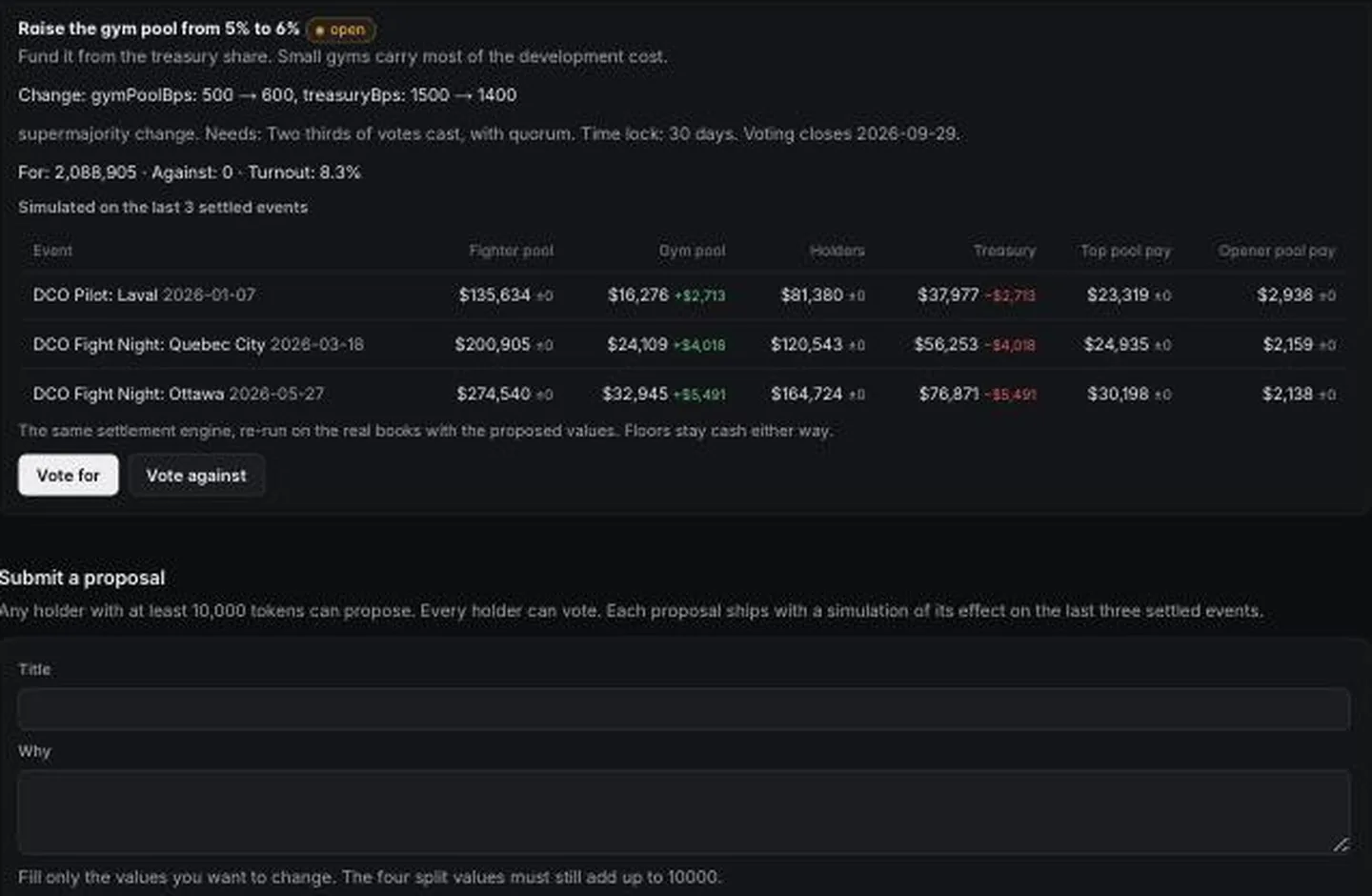
Mechanics. Every holder can vote. The holding it takes to submit a proposal is still to be set. Voting runs for seven days. Quorum is 10% of voting tokens; a supermajority is two-thirds of votes cast; simple-majority changes take effect after 7 days. Each proposal ships with a plain-language summary and a simulation of its effect on the last three settled events' payouts, computed by re-running the real settlement engine with the proposed numbers.
Section 12
12Legal and regulatory path
A token that pays holders a share of profit is a security in Canada and the United States. The DCO treats that as a feature. An organization whose pitch is transparency should be the most compliant one in the sport.
Securities
| Topic | Approach |
|---|---|
| Classification | A security under the Howey test (US) and the Pacific Coast Coin test (Canada). No "utility token" framing |
| Token standard | A permissioned security token (ERC-3643) that moves only between identity-verified wallets, with holding periods and investor caps enforced in the contract |
| Canada first | Accredited-investor and offering-memorandum exemptions under NI 45-106, a small start-up crowdfunding tranche for fans, filings with the AMF, bilingual disclosure in Quebec |
| United States later | Reg A+ Tier 2 for a retail-eligible raise, Reg D 506(c) for accredited investors, Reg CF as an optional pilot. US persons are geofenced out until then |
| Fighter tokens | Issued as compensation with lockups and tax withholding. Taxed as income at fair market value on receipt |
| Secondary trading | Registered venues only. Never a listing on a decentralized exchange |
| Money handling | Licensed custodians and payment rails, so the organization does not become a money transmitter. FINTRAC registration in Canada |
Combat sports. Every event needs a licensed promoter of record, commission sanctioning, licensed officials, medicals and insurance. In Quebec that is the RACJ. In the US it is state by state. The event operator holds those licenses. Commissions approve each matchup, and the ELO band gives them a stronger record of competitive matchmaking than most cards can show. The software will not record a result until the commission checklist is complete and both fighters have weighed in.
The Ali Act. The original Act does not cover MMA, and the Revival Act is a boxing bill. Neither binds an MMA organization. The DCO adopts the original Act's protections anyway, by construction.
| Original Ali Act principle | DCO design |
|---|---|
| Rankings independent of the promoter | ELO published by a party that never owns the promotion's margin |
| Promoter must disclose its bout revenue to the boxer | The full event ledger is public to everyone |
| Limits on coercive long-term contracts | One-bout, non-exclusive contracts |
| Firewall between promoter and manager | No promoter interest to conflict with. Operators work for a flat fee |
| Fighter's right to sue | Kept. Arbitration is available, never mandatory |
If the Revival Act becomes law, boxing gets promoter-controlled rankings and titles inside Unified Boxing Organizations. A boxing version of the DCO could then sit beside them as the fighter-owned alternative. Whether it would register as a UBO or operate under the traditional rules is a question for counsel once the final text is known.
Two bright lines
- No payout tied to a fight result. Holder distributions come from gate, media and sponsorship profit. A payout that depends on who wins would make the token a wager.
- No betting. No sportsbook, prediction market or betting sponsor in the first version. A public rating with public money is attractive to bettors, and that multiplies the incentive to fix fights.
Worker status. Fighters remain independent contractors. Non-exclusive one-bout contracts make that classification more defensible than it is under long exclusive deals. The tax treatment of token pay needs a specialist in each jurisdiction.
Section 13
13Risks and attack surface
The model is coherent on paper. The hardest risk is commercial, not technical: ownership in an organization that loses money is worth nothing.
| Risk | How it shows up | Mitigation |
|---|---|---|
| Talent cold start | The best fighters are under exclusive UFC or PFL contracts and cannot sign | Start with free agents, regional champions and released veterans. One-bout contracts let any unsigned fighter try one fight. Exclusive contracts elsewhere expire |
| Revenue cold start | No media deal, small gates, thin profit, tiny distributions | Launch-sale proceeds fund a loss reserve that guarantees floors. Combat Edge's media reach supplies an early audience. Free prelims on YouTube and creator co-streams build reach at no rights cost (Section 8). Target regional-scale events first |
| ELO measures skill, not drawing power | A popular 1700 fighter sells more than a quiet 1850 and is paid less | A 10% commission on tickets and main-card streams sold through the fighter's own link, 100% of personal sponsorship and gear auctions. The pay formula stays pure |
| Distribution | Platforms decline to open pay-per-view or co-streaming tools; the main-card feed leaks; a creator misbehaves on air | A white-label paywall works from the first event without any platform deal. Per-viewer forensic watermarking and live takedowns, plus Canada's July 2026 dynamic site-blocking order. Revocable creator approval under a public license. No casino-owned platforms as partners |
| Rating manipulation | Collusion to trade wins, or pressure on the rating publisher | Opponent-weighted math makes padded wins nearly worthless. Signed rating updates, public methodology, no retroactive changes, no holder vote on ratings |
| Fight fixing | A public pay formula makes the value of a result calculable | No betting products. Forfeiture of unvested tokens and a lifetime ban for fixing. Commission and integrity-monitor review of unusual results |
| Cherry-picking and ducking | Fighters hunt favorable styles or sit on a rating | ELO band, duty to defend, ranking deductions; silence counts as a decline |
| Governance capture | Large holders vote down the fighter share | Constitutional floor at 40%, 75% supermajority of all tokens, time locks, reserve tokens flowing only to fighters, fighters free to leave |
| Oracle centralization | Combat Edge publishes the rating and also runs the flagship | Independent ratings committee with a public change log. Open methodology, so anyone can recompute every rating. Long term, move the ELO into a separate non-profit body |
| Token volatility | A falling price erodes the retirement story | Cash floor plus at least 50% cash. Verified-wallet trading on regulated venues. Value anchored to real distributions |
| Retirement sell-off | Many veterans sell at once | Four-year streaming on each grant. Holding keeps paying, so selling has a visible cost |
| Revenue attestation | Someone under-reports the gate or pads a cost line | Provider attestations, independent auditor, document hashes on-chain, budget-versus-actual review, operator removal by vote |
| Fighter safety | Self-booked fighters take fights too often or while hurt | Commission medicals and suspensions enforced in the contract. A 45-day minimum rest between bouts, checked at signing and again on the real event date. A health fund from the treasury |
| Regulatory | A securities or commission regulator rejects part of the structure | Canada first, with early AMF engagement. Compliance enforced in the token itself. Nothing issued before counsel signs off |
| Reputation | "Crypto plus cage fighting" invites cynicism | Lead with the public ledger and fighter pay, not the token. Behave like regulated sports infrastructure |
One risk deserves a plain statement. If the incumbent raises fighter pay in response, the DCO has partly succeeded even if it stays small. For fighters that is a good outcome. For token holders it is a competitive threat.
Section 14
14Partners: who it takes to make this real
This paper is a proposal looking for partners, not a launch schedule. The rules already run in software. A first real card takes people Combat Edge does not have in house, and no money or token changes hands until counsel signs off.
What Combat Edge brings. The rating, which already covers 4,007 professional fighters; the software that runs the rules in this paper (Section 15); and the reach of combat-edge.com among fans who follow the numbers. It does not have a promoter's license, a venue, a production crew, securities counsel or a token platform. Those come from partners.
| Partner | What they would do | What is ready for them today | What is in it for them |
|---|---|---|---|
| A promotion or event operator | Run one real card through the ledger in parallel with its own books, as a shadow event. Then stage DCO events as the licensed promoter of record | Ready The ledger, auditor review and settlement engine can take a real card | A fixed fee bid in the open, and the first cards in the sport with public books |
| Fighters, managers and gyms | Join the list of licensed fighters. Try the challenge flow. Say where the contract or the formula is wrong | Built The pay simulator and the fighter waitlist with license review. The challenge app runs on demo data | Pay by a public formula, one-bout contracts, a gym pool and a stake in the organization |
| Creators, platforms and broadcasters | Co-stream the free windows, sell ticketed cards from a storefront, open platform tools to the league, or license a card (Section 8) | Designed The co-stream license and the storefront model are specified. Storefronts are not built yet | Channel earnings, commissions and markup, and sales attributed in public |
| Sponsors | Bid for event spots and fighter gear in open auctions (Section 7) | Built Open ascending auctions, folded into the event's gross | Placement at a public price, on a card where the check lifts every fighter's purse |
| Counsel and token infrastructure | Confirm the securities and combat-sports structure. Issue a permissioned security token, with custody, identity checks and payment rails (Section 12) | Modeled Token and settlement contracts are written and tested on a local test chain, and stay locked | An issuer whose revenue is public, attested and audited event by event |
| Investors | Fund the launch and the loss reserve that guarantees fighter floors, through a compliant offering once counsel signs off | Modeled The waterfall, the token and the governance guards (Sections 7, 10 and 11), and the risks (Section 13) | A pro-rata share of every event's profit. Nothing is offered by this paper |
One fixed order. Partners can arrive in any order, with one rule that does not move: nothing that touches securities law happens before counsel signs off. Publishing, the simulator, the fighter list, signing bouts with no money attached and a shadow event carry no securities exposure and can start now. A token sale, token pay and on-chain settlement wait for the legal structure. The first real card needs three things at once: a licensed operator, enough signed, band-valid bouts to fill it, and a loss reserve that guarantees the floors.
What a first step looks like. For a promotion, it is a shadow event: one real card run through the ledger in parallel, with nothing changed on the night, to show what every fighter would have earned. For a fighter or a gym, it is the simulator and the list. For everyone else, it is a conversation. The paper, the simulator and a list for updates are at combat-edge.com, and partnership inquiries go to info@combat-edge.com.
What Combat Edge packages for adopters. The challenge app, the card sorter, the settlement ledger, the token and vesting contracts, the fighter wallet, the public transparency dashboard and the compliance layer. An operator who wants to run a DCO licenses the stack and plugs into the shared ELO.
Section 15
15What exists today
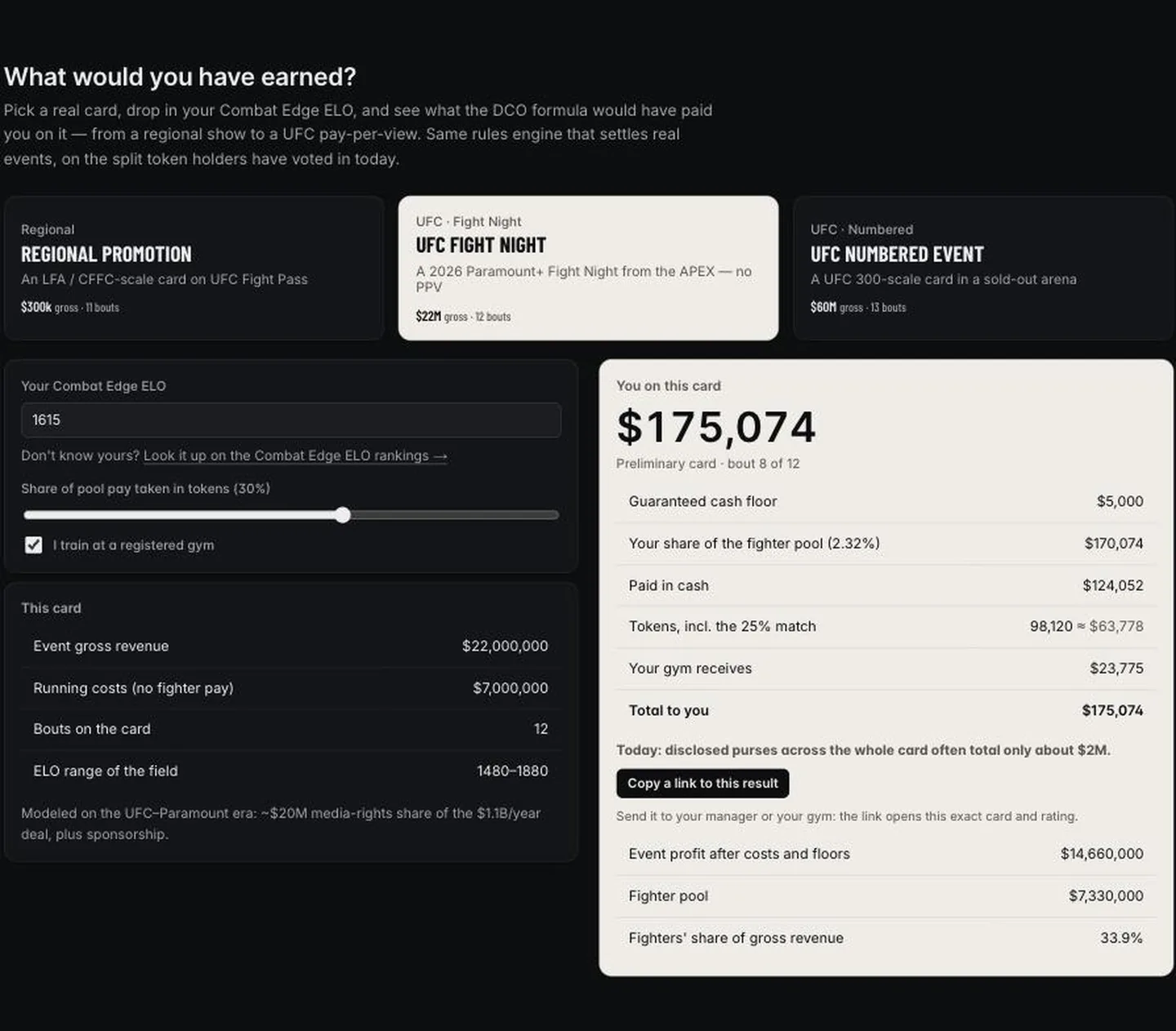
The rules in this paper run in working software, DCO OS, on fictional demo data, except operator bidding and operator votes, and creator storefronts (Section 8). The token and settlement contracts are written and tested on a local test chain, and stay locked until counsel signs off. No money moves, no token exists and there is no real sign-in yet. What it proves is that the model is specific enough to build, and that its numbers add up to the cent.
| Paper section | What runs in the software |
|---|---|
| §3 ELO | Ratings imported read-only from Combat Edge. True ELO never changes inside the app; duty deductions touch pay ELO and rank only |
| §5 Matchmaking | Named and open challenges with rounds, a date window and a region; the 64% band; rest, medical and suspension checks; open-challenge nights awarded to the highest-rated taker; suggested matchups for available fighters; duty to defend; fan demand; the readable one-bout agreement |
| §6 Card | Sort by average ELO, ties, title fights, five-round mains, lock 14 days out that freezes ratings, gyms, elections and rules |
| §5 Fight week | Commission checklist, weigh-ins with a named official and one re-weigh, standby list, short-notice replacement with premium, cancellations paid at the floor |
| §7 Waterfall | Attested revenue and cost lines, open sponsorship auctions folded into gross, auditor approval voided by any later change, loss reserve, league deals released through each covered event |
| §9 Pay | The formula with spread S, cash or tokens with the 25% match, ticket-link commission, gear auctions paid to the fighter, the gym pool |
| §10 Token | Fixed supply and allocations, the 30-day price, vesting, distributions to holders of record, forfeiture of unvested tokens after a fixing finding |
| §11 Governance | One token one vote, the constitutional floor, time locks, change classes judged against pending changes, and a three-event impact simulation on every proposal |
| Public tools | The public simulator with shareable links, the fighter waitlist, and a public transparency page that aggregates every settled event |
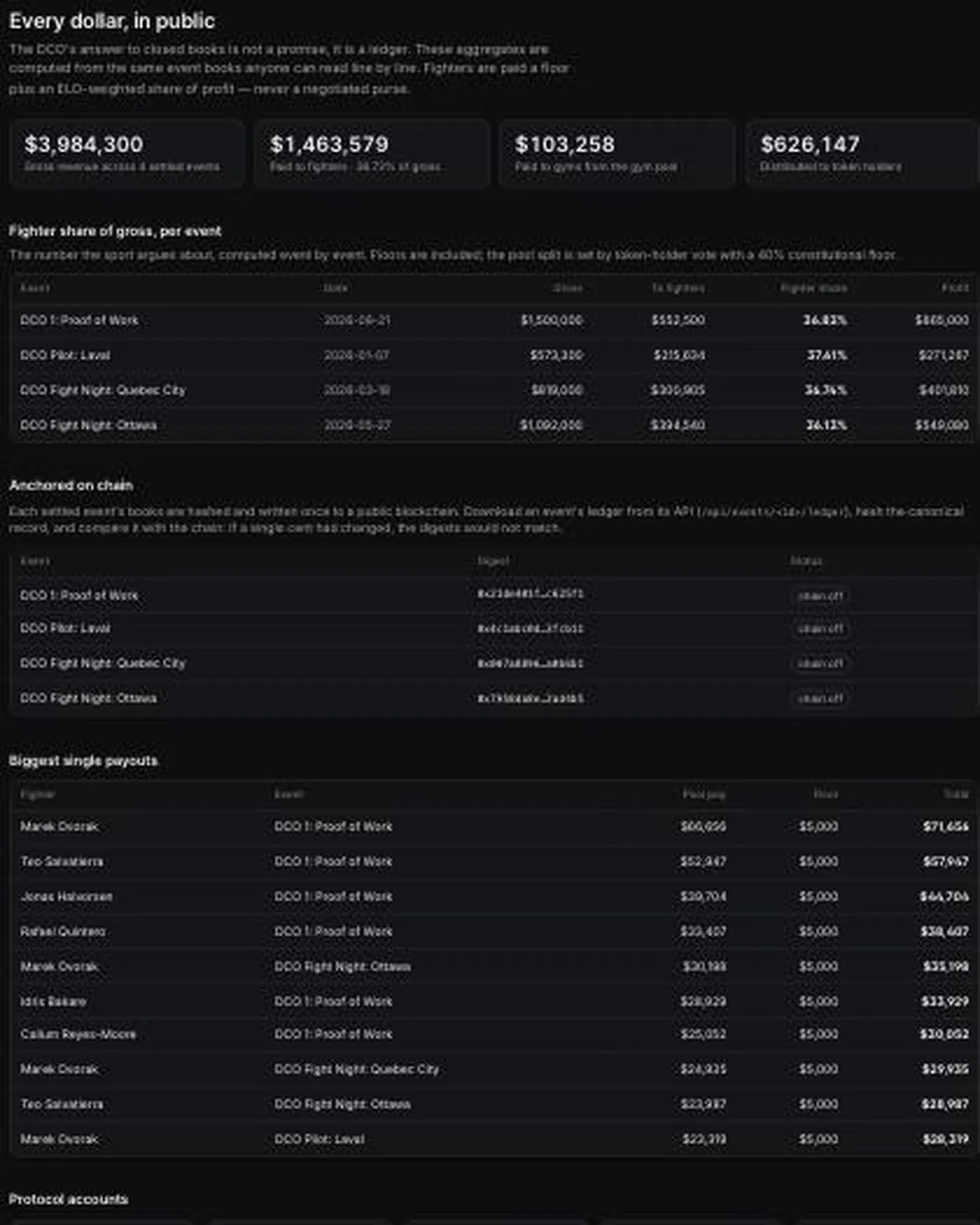
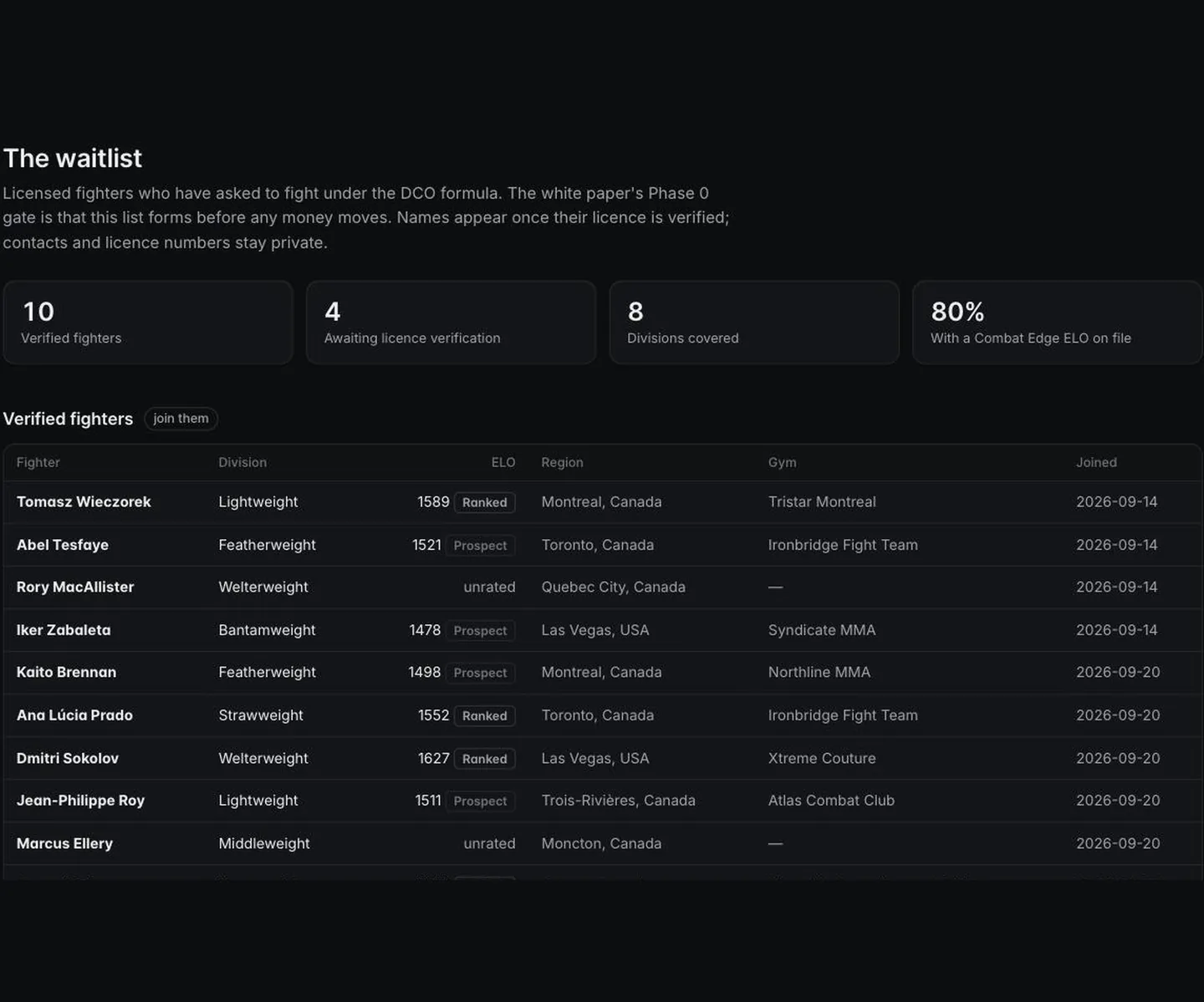
Before real fighters use it. The software needs production sign-in and hosting, a live rating feed from combat-edge.com, and accounts for commission officials. The token, identity checks and custody wait for counsel, as Section 12 requires.
Section 16
16Open questions
What is settled for now, and what we want to work out with partners. Where we lean one way on an open point, we say so. All of it is open to discussion.
Settled for now
| Question | Where it stands |
|---|---|
| Distribution | The protocol is agnostic: free, ticketed, membership or licensed, every window settles through the same ledger. The flagship's reference design is free prelims on every platform and, when a main card is ticketed, one paywall with storefronts for fighters and creators. No exclusive rights sold at launch (Section 8) |
| Short-notice replacements | A standby list and a flat $2,500 premium (Section 5) |
| Fan staking on fighters | Out. It ties payouts to results and crosses the betting line in Section 12 |
Still open
None of these is fixed. We would rather settle them with the people who will run, fight on and fund the first cards than on our own.
- The pay spread S. At 400 the main-eventer earns about 17 times the opener's pool share. At 600 it is under 7 times. We lean toward launching at 400, because it matches the ELO scale and gives headliners a reason to sign, with holders free to tune it afterward.
- Cross-division ELO. An 1850 flyweight and an 1850 heavyweight are paid the same. That is fair on merit, but divisions differ in depth. We would live with that for a first version and look again once real cards have run.
- Drawing power. ELO pays skill, not ticket sales. The current design gives every fighter a ticket link and 10% of what it sells, gate tickets and main-card streams alike, and gives creators the same 10% (Sections 8 and 9). Whether a commission is the right tool, and whether 10% is the right number, is up for discussion.
- Which main cards to ticket. A free main card trades ticket revenue for reach that sponsors pay for. Our thinking is to decide card by card, and to publish the comparison once both kinds have run.
- Main-card price and creator markup. For ticketed cards, $20 list against a $8.99 monthly UFC subscription, and a markup cap of $10. One option is to hold $20 for the first three ticketed cards, publish buys by storefront, and let holders vote on price once there is data.
- Whose pay-per-view. If YouTube opens its pay-per-view tool, running the main card there trades some control and an undisclosed platform share for reach and a one-tap purchase. For now we would keep the white-label paywall as the ledger of record and add YouTube as one more storefront if the terms allow attribution.
- Short-notice premium. Whether it should scale with card position. We would keep it flat until there is data on how often replacements happen.
- Coaches. Whether head coaches should be able to receive part of a gym's share directly. The simplest answer may be to let each gym set a split with its coaches, recorded like a fighter's two-gym split.
- Who publishes the ELO long term. Combat Edge running both the rating and the flagship is the paper's weakest point on independence. We think the ELO should move under an independent body before other organizations launch on the protocol. How to set that up is open.
- Launch split. 50% fighters, 5% gyms, 30% holders, 15% treasury, with a 40% constitutional floor on the fighter pool. Does 30% give investors enough to fund the launch? That needs a financial model with a realistic event calendar.
- Name. "Decentralized Combat Organization" works as a category name. The flagship and the token need their own names.
- Grappling and amateur feeders. The same challenge app could run amateur or grappling cards with no token, to build the fighter base before any token exists. We think it is worth testing early.
What comes next. A financial model of the flagship's first three years, a methodology note for the rating rules backtested on Combat Edge's historical data, and a term sheet for a shadow-event partner.
Appendix A
The DCO on one page, for fighters
No promoter. No purse negotiation. No exclusive contract. You pick your fights, a public formula pays you, and you can own part of the organization you fight for.
You choose who you fight
Call out anyone in your weight class whose Combat Edge ELO is within about 100 points of yours. Name the rounds, a date window and a region. If they accept, you both sign a one-bout contract. Or post an open challenge, and the best-rated fighter who answers gets the fight.
The card is ordered by rating
The fight with the highest average rating is the main event. Nobody buries you on the prelims for being unmarketable, and nobody pushes a prospect past you.
You are paid by formula
Every fighter gets a $5,000 cash floor, win or lose, even if the event loses money. On top, you get a share of half the event's profit, set by your rating. On the $1.5 million sample card that was $8,970 for the opener and $71,656 for the main-event favorite. The whole ledger is public, so you can check every number.
Winning pays through your rating
There is no win bonus. A win raises your ELO, and a higher ELO raises your pay in every fight after it. Beating better fighters is what moves the number. Taking a hard fight and losing costs you little.
Cash, or a stake
The floor is always cash. For the rest you choose: all cash, or up to half in tokens, with a 25% bonus from the Fighter Reserve. Tokens pay you a share of every event's profit for as long as you hold them, fighting or retired.
Your crowd and your kit pay you too
Sell tickets and main-card streams through your own link and keep 10%. Auction the spots on your shorts and walkout shirt; that money is yours. Personal sponsors stay 100% yours.
Your gym gets paid, not from you
A separate gym pool pays the gym you name for every card you are on. It never comes out of your purse.
The fine print that protects you
- One bout at a time. No option years, no champion's clause.
- Pay rules change only after a vote's delay, and never for a card that has already locked. The fighter pool can never fall below 40% of profit.
- Commission medicals, suspensions and a 45-day minimum rest are enforced by the software.
- Arbitration is available. Your right to go to court is kept.
Try it
Open the pay simulator, enter your Combat Edge ELO and pick a card. Then join the waitlist of licensed fighters.
Appendix B
Glossary
- Band
- The rule that makes a challenge valid only if the favorite's ELO win probability is 64% or lower, a gap of about 100 points.
- Card lock
- The moment, 14 days before an event, when ratings, gym affiliations, cash-or-token elections and the governance rules freeze for that event.
- Combat Edge ELO
- A promotion-blind rating of every professional MMA fighter. Wins against higher-rated opponents move it most. Published by Combat Edge, never voted on.
- Constitutional floor
- The fighter pool can never be set below 40% of profit, and cash floors can never be cut, without 75% of all voting tokens and a 90-day delay.
- DCO
- Decentralized Combat Organization: a promotion run on public rules, a public ledger and a public rating, owned by token holders who are increasingly its fighters.
- Duty to defend
- A top-five fighter who declines valid challenges from three different top-ten opponents in 12 months loses ranking and pay ELO until they sign a fight.
- Fighter Reserve
- 40% of token supply, earned only by fighting. Pays the 25% match on fighters' token elections. Reserve tokens do not vote.
- Floor
- The guaranteed cash paid to every fighter on a card: $5,000 in the straw man. A cost of the event, not a share of profit.
- Gym pool
- 5% of profit, paid to the gyms of the fighters on the card: half split equally per fighter, half by each fighter's pool share.
- League deal
- Organization-level revenue, such as a multi-event media deal, booked to the treasury and released in equal parts through each covered event's waterfall.
- Loss reserve
- Treasury money set aside to pay fighter floors when an event loses money.
- Open challenge
- A call-out to anyone in the band. Fighters put their names in for seven days; the highest-rated valid taker gets the fight.
- Operator
- The licensed promoter of record who stages an event for a fixed fee, bid in the open. Holds the commission licenses. Keeps no margin.
- Pay ELO
- The rating used for pay: true ELO minus any duty-to-defend deduction.
- Spread (S)
- The governance number that sets how steeply pay rises with rating. At S = 400, a 400-point gap means ten times the pool share.
- Standby
- A fighter who agrees in advance to step in if someone withdraws after the card locks. Earns a $2,500 short-notice premium if used.
- True ELO
- The published rating itself. It never decays and is never changed by the DCO.
Appendix C
Sources
- TKO Group Holdings, "TKO Reports Fourth Quarter and Full Year 2025 Results" (UFC revenue $1,502.2M, adjusted EBITDA $851.0M). investor.tkogrp.com
- Cohen Milstein, "$375 Million Antitrust Settlement Provides Life-Changing Money to UFC Fighters" (class size, Boulware quote). cohenmilstein.com
- Courthouse News, "Judge grants final approval of $375 million UFC antitrust settlement". courthousenews.com
- Joseph Saveri Law Firm, UFC antitrust litigation (Johnson v. Zuffa, Cirkunovs v. Zuffa). saverilawfirm.com
- Paul Gift, "UFC Fighter 'Wage Share' Held Steady At 19–20% For 11 Straight Years", Forbes, April 2022. forbes.com
- ProMarket, "Cung Le v. Zuffa Promised To Change the UFC" (13–15% in 2023; about half in the NFL, NBA and NHL). promarket.org
- theScore, NBA revenue split under the current CBA (49–51% of BRI); NBC Sports / PFT, NFL players' share up to 48.8%. thescore.com · nbcsports.com
- Sportico, House passage of the Muhammad Ali American Boxing Revival Act by voice vote (H.R. 4624). sportico.com
- U.S. Senate Commerce Committee, "Cruz, Rosen Celebrate Committee Passage" (S. 5188, September 16, 2026). commerce.senate.gov
- Fightnews, "The Muhammad Ali American Boxing Revival Act headed to full Senate". fightnews.com
- Athlon Sports, "House Passes Muhammad Ali Boxing Revival Act: Key Changes Explained" ($200 per round, $50,000 medical coverage, UBOs, critics). athlonsports.com
- BoxingInsider, "Boxing Needs Reform. This New Ali Act Revival Bill Needed a Debate." (six-year UBO contracts, mandatory arbitration). boxinginsider.com
- UFC, "UFC and Meta Unveil Meta UFC Rankings", June 2026. ufc.com
- UFC, official judges' scorecards, UFC 306: O'Malley vs. Dvalishvili. ufc.com
- Combat Edge ELO methodology, ratings and point swings. combat-edge.com
- SportsPro, UFC, boxing and the end of US pay-per-view (Paramount, $7.7B over seven years). sportspro.com
- Tom's Guide, UFC 326 in Canada (C$69.99 pay-per-view); 100 Mile Free Press, UFC's move to Paramount+ Canada in 2027. tomsguide.com · 100milefreepress.net
- MMA Crossfire, report of about 10,000 North American buys for PFL Battle of the Giants. mmacrossfire.com
- Awful Announcing, Power Slap leaves Rumble for YouTube; Fightnews, Dirty Boxing Championship. awfulannouncing.com · fightnews.com
- Streams Charts, La Velada del Año VI recap; Digiday, NFL creator-led broadcasts on YouTube. streamscharts.com · digiday.com
- YouTube Help, Pay-Per-View availability; YouTube, channel memberships; YouTube Help, Content ID for live streams and allowlisting. support.google.com · youtube.com · support.google.com · support.google.com
- YouTube Official Blog, 2025 NFL season and Watch With. blog.youtube
- Twitch, ads incentive program; TwitchCon Rotterdam 2026 announcements. blog.twitch.tv · blog.twitch.tv
- Amazon Video Central, requirements for live events on linear channels; Cageside Press, ONE Championship on Prime Video in 2026. videocentral.amazon.com · cagesidepress.com
- Kick, revenue split; Wikipedia, Kick (ownership). help.kick.com · wikipedia.org
- POST Wrestling, AEW suing TrillerTV for nearly $5 million. postwrestling.com
- Dacast, pay-per-view commissions; SVG, Kiswe Core. dacast.com · sportsvideo.org
- Friend MTS, forensic watermarking in live sports; Broadcast Dialogue, Federal Court dynamic blocking order (July 2026). friendmts.com · broadcastdialogue.com
- Esports World Cup, co-streaming rights; LowKick MMA, UFC Muted; John Wall Street, Kings League. esportsworldcup.com · lowkickmma.com · johnwallstreet.com