Fighters make the fights
Any registered fighter can challenge another in their weight class. If the matchup is competitive by rating, both sign a standard one-bout contract. No purse to negotiate. No exclusivity.

Combat Edge white paper · draft v1
A fighter-owned, Elo-governed MMA promotion. Fighters book their own fights, a public rating sets the card and the pay, and every dollar moves on a public ledger.
The problem
MMA's problem is not the fights. TKO reported UFC revenue of $1.502 billion for 2025 and adjusted EBITDA of $851 million, a 57% margin. Expert reports in the UFC antitrust case put the fighters' share of event revenue at 19 to 20% from 2011 to 2017, and analyses of SEC filings since then put it at 13 to 16%. NBA, NFL and NHL players receive about half of league revenue. MMA fighters have no union, no draft and no floor.
| Failure today | DCO answer |
|---|---|
| The promoter decides who fights whom, and can freeze out a fighter | Fighters challenge each other directly |
| The promoter controls rankings and titles | Independent, promotion-blind Combat Edge ELO |
| Purses are private and negotiated one by one | One public pay formula for everyone |
| Finances are closed | Every revenue and cost line on a public ledger |
| Fighters leave with no equity and no pension | A revenue-paying token earned by fighting |
The model
A DCO is an MMA promotion with no promoter in the middle. Everything a promoter decides in private today becomes a formula, a vote or a competitive bid. Every bout is still sanctioned by the local commission, and every event has a licensed promoter of record working for a fixed fee.
Any registered fighter can challenge another in their weight class. If the matchup is competitive by rating, both sign a standard one-bout contract. No purse to negotiate. No exclusivity.
Bouts are ordered by the average rating of the two fighters. Highest average is the main event, lowest opens the prelims. Nobody is buried or pushed for marketing reasons.
Each event starts with gross revenue. Venue, production, labor, commission fees and fighter floors come off as itemized cost lines on a public ledger. What is left is profit.
The fighter pool is divided by each fighter's pre-fight ELO, frozen when the card locks. A small gym pool pays the teams that trained the fighters, on top of the purse and never out of it.
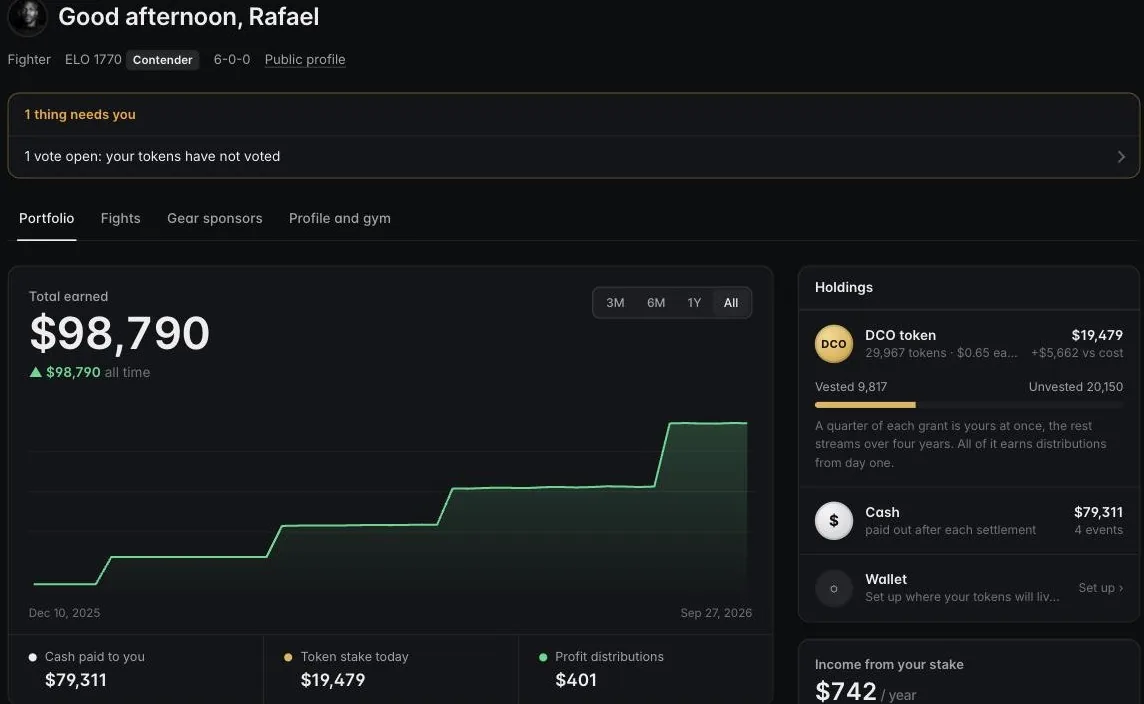
Fighters choose how much of their pool pay to take in cash and how much in tokens. Tokens receive a share of every event's profit, so a fighter who holds keeps earning after the last fight.
The model does not depend on how fans watch. A free stream, a ticketed card, a membership or a rights deal all run through the same ledger and the same split. It fits decentralized distribution best: creators and fighters carry and sell the feed.
Pay simulator
Pick a card, enter a Combat Edge ELO, and see what the DCO formula would have paid on it, from a regional show to a UFC numbered event. It runs the same settlement engine as the worked example in the paper.
| Event gross revenue | $22,000,000 |
| Running costs, before fighter pay | $7,000,000 |
| Bouts on the card | 12 |
| ELO range of the field | 1480–1880 |
Modeled on the UFC–Paramount era: ~$20M media-rights share of the $1.1B/year deal, plus sponsorship.
You on this card
$175,074
Preliminary card · bout 8 of 12
| Guaranteed cash floor | $5,000 |
| Your share of the fighter pool (2.32%) | $170,074 |
| Total to you | $175,074 |
How it is paid
| Paid in cash | $124,052 |
| Taken in tokens | $51,022 |
| Tokens you receive, with the 25% match on top | 98,120 ≈ $63,778 |
| Your gym also receives | $23,775 |
Today: disclosed purses across a whole Fight Night card often total only about $2M.
| Event profit after costs and floors | $14,660,000 |
| Fighter pool | $7,330,000 |
| Fighters' share of gross revenue | 33.9% |
Card revenue and costs are modeled from public figures. Token amounts are illustrative at a straw-man price of $0.65: no token exists, and nothing here is an offer.
E is the fighter's pre-fight ELO. S is the spread, one number set by governance. At S = 400, a fighter rated 400 points higher earns ten times the pool share. There is no show money, no win bonus and no negotiation. A win pays through the rating.
| Fighter | ELO | Pool share | Total with floor |
|---|---|---|---|
| Main event, favorite | 1890 | 15.41% | $71,656 |
| Main event, underdog | 1850 | 12.24% | $57,947 |
| Main card | 1700 | 5.16% | $27,327 |
| Prelim | 1615 | 3.16% | $18,688 |
| Prelim | 1500 | 1.63% | $12,061 |
| Opener | 1400 | 0.92% | $8,970 |
The event revenue waterfall
What came in, what it cost line by line, and where the profit went. Anyone can read it. Each revenue figure is attested by the provider that collected it and reconciled by an independent auditor before settlement.
| Cost line | Amount | Who sets it |
|---|---|---|
| Venue and arena | $80,000 | Operator bid |
| Production and broadcast | $150,000 | Operator bid |
| Event operator fee | $60,000 | Operator bid, approved budget |
| Marketing and promotion | $60,000 | Approved budget |
| Security and event staff | $50,000 | Operator bid |
| Medical and insurance | $40,000 | Commission rules |
| Fighter travel and lodging | $40,000 | Protocol standard |
| Commission and officials | $20,000 | Statute |
| Fighter cash floors (24 × $5,000) | $120,000 | Governance |
| Protocol fee (1% of gross) | $15,000 | Governance |
| Total costs | $635,000 |
The opening split is a straw man that token holders can change by vote, inside guards: the fighter pool cannot go below 40% of profit and cash floors cannot be cut without 75% of all voting tokens and a 90-day delay.
Floors are a cost, not a share. A fighter is paid the floor even if the event loses money.
Distribution
The model is agnostic to distribution. Any way of showing the fights that produces attested revenue runs through the same ledger and the same split, and not every main card needs to be pay-per-view. How an event reaches its audience is a commercial choice made card by card, not a rule of the protocol.
| Window | How the money comes in | What the ledger books |
|---|---|---|
| Free stream | Sponsorship auctions, and a wider audience for the gate | Sponsor bids at the closing price, and ad revenue as the platform reports it |
| Ticketed main card | A one-event ticket, sold by the DCO, the fighters and approved creators | Each sale at list price, attributed to its storefront |
| Membership | A recurring pass on the DCO's own channel or on a platform | Organization-level revenue, released through the events it covers |
| Media-rights deal | A fee from a broadcaster or platform for one card or a season | Booked to the treasury and released in equal parts through each covered event |
The rest of the DCO removes a gatekeeper and publishes the numbers. Distribution can work the same way. When creators and fighters carry and sell the feed, there is no single broadcaster to depend on, the people who bring an audience are paid for it, and every sale is attributed on the ledger.
Prelims stream free and any approved creator can co-stream them with their own commentary. A main card can go out free on the same terms. When a main card is ticketed, it is sold once, for $20, through one paywall with many storefronts.
| Storefront | Price | What the buyer gets | Who earns what on a ticket |
|---|---|---|---|
| DCO page | $20 | The clean feed, with the house commentary track as an option | The full $20 goes into the event's gross |
| Fighter link | $20 | The same ticket | The fighter earns 10%, the same commission as on gate tickets |
| Creator storefront | $20–$30 | The clean feed with the creator's commentary as the default audio | The creator earns 10% of list, plus any markup they set, up to $10 |
What exists today
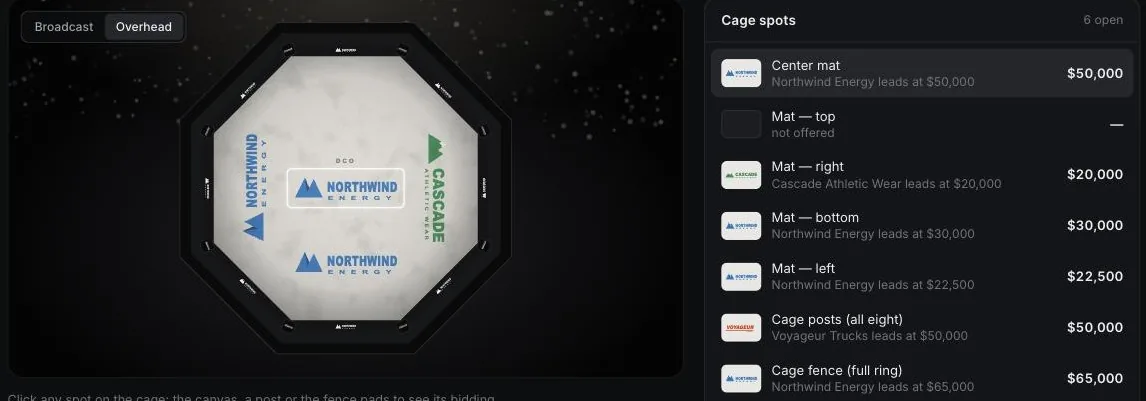
The rules for fighters, cards, pay, the ledger and governance run in working software, DCO OS, on fictional demo data. No money moves, no token exists and there is no real sign-in yet. What it proves is that the model is specific enough to build, and that its numbers add up to the cent.
The full argument
Sixteen sections: the problem, the Combat Edge ELO, matchmaking, the revenue waterfall, distribution, fighter compensation, the token, governance, the legal path, the risks without softening them, and what is still open. It may be shared freely in full.
Draft v1 · October 2026 · by Fred Lambert
Read Appendix A first, then Sections 5 and 9. Then use the simulator above with your Combat Edge ELO.
Section 9 explains the gym pool: a cut of every event's profit for each fighter you put on a card, paid on top of the fighter's purse.
Partners
This is a proposal looking for partners, not a launch schedule. Combat Edge brings the rating, the software that runs the rules, and the reach of combat-edge.com. It does not have a promoter's license, a venue, a production crew, securities counsel or a token platform. Those come from partners.
| Partner | What they would do | What is ready for them today | What is in it for them |
|---|---|---|---|
| A promotion or event operator | Run one real card through the ledger in parallel with its own books, as a shadow event. Then stage DCO events as the licensed promoter of record | Ready The ledger, auditor review and settlement engine can take a real card | A fixed fee bid in the open, and the first cards in the sport with public books |
| Fighters, managers and gyms | Join the list of licensed fighters. Try the challenge flow. Say where the contract or the formula is wrong | Built The pay simulator on this page. The challenge app and the fighter waitlist run on demo data | Pay by a public formula, one-bout contracts, a gym pool and a stake in the organization |
| Creators, platforms and broadcasters | Co-stream the free windows, sell ticketed cards from a storefront, open platform tools to the league, or license a card | Designed The co-stream license and the storefront model are specified. Storefronts are not built yet | Channel earnings, commissions and markup, and sales attributed in public |
| Sponsors | Bid for event spots and fighter gear in open auctions | Built Open ascending auctions, folded into the event's gross | Placement at a public price, on a card where the check lifts every fighter's purse |
| Counsel and token infrastructure | Confirm the securities and combat-sports structure. Issue a permissioned security token, with custody, identity checks and payment rails | Modeled Token and settlement contracts are written and tested on a local test chain, and stay locked | An issuer whose revenue is public, attested and audited event by event |
| Investors | Fund the launch and the loss reserve that guarantees fighter floors, through a compliant offering once counsel signs off | Modeled The waterfall, the token and the governance guards, with the risks listed plainly in the paper | A pro-rata share of every event's profit. Nothing is offered on this page |
One fixed order. Partners can arrive in any order, with one rule that does not move: nothing that touches securities law happens before counsel signs off. The simulator, the fighter list, signing bouts with no money attached and a shadow event carry no securities exposure and can start now.
Get involved
The first step is a shadow event: one real card run through the ledger in parallel, with nothing changed on the night, to show what every fighter would have earned.
Run your Combat Edge ELO through the simulator, then join the list as a fighter or a gym. You will hear first when registration opens.
Start a conversation. Tell us what you would bring and what you would need to see first.
A concept and feasibility study. Not an offer of securities and not legal advice. All figures are straw-man numbers for testing the model. Nothing in the software moves money or issues a token, and nothing will be issued before counsel signs off.
© 2026 Combat Edge. Screens showing the DCO OS software use fictional fighters, gyms, sponsors and money.