
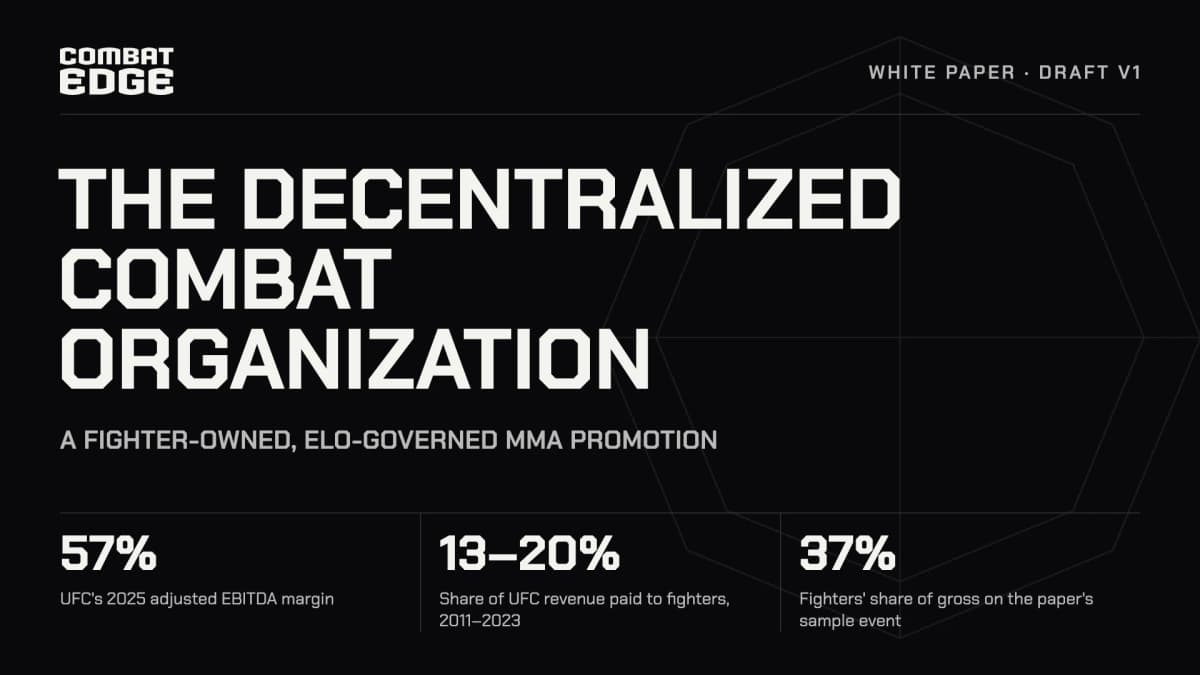
The UFC kept 57 cents of every dollar it made last year as adjusted EBITDA. Its fighters have been getting between 13 and 20 cents.
Today Combat Edge is publishing a white paper that describes the opposite structure and how to build it. We call it the Decentralized Combat Organization, or DCO: an MMA promotion with no promoter in the middle. Fighters book their own fights. A public rating sets the card and the pay. Every dollar moves on a public ledger.
The goal of the model is to put every incentive in the right place, so the sport works better for everyone with a stake in it: fighters, gyms, operators, sponsors, fans and the people who fund the cards. Each of them is rewarded on merit.
You can read the full paper on the site or download it as a PDF. You can also skip straight to the pay simulator, enter a Combat Edge Elo, and see what the formula would have paid on a real card.
One company holds the contracts, the rankings and the books
MMA's problem is not the fights. The numbers below come from TKO's own filings and from the court record.
| Measure | Figure |
|---|---|
| UFC revenue, 2025 | $1.502 billion |
| UFC adjusted EBITDA, 2025 | $851 million, a 57% margin |
| Fighters' share of event revenue, 2011 to 2017 | 19 to 20%, per expert reports in the UFC antitrust case |
| Fighters' share since | About 16% in 2022 and 13 to 15% in 2023, per analyses of SEC filings |
| Players' share in the NBA, NFL and NHL | About half |
TKO reported the revenue and the margin. The courts have looked at the rest. In Le v. Zuffa, a class of about 1,100 fighters won a $375 million settlement that received final approval on February 6, 2025. The claim was that the UFC used exclusive contracts and market power to hold pay down.
The law that protects boxers from this never covered MMA. And Congress is now moving boxing toward the MMA model instead of the reverse: the Muhammad Ali American Boxing Revival Act passed the House in March and cleared the Senate Commerce Committee on September 16. It would let one organization promote fights, set rankings and crown champions under one roof.
What replaces the promoter
A formula, a vote or an open bid. Every bout is still sanctioned by the local commission, and every event still has a licensed promoter of record, paid a fixed fee.
| Failure today | DCO answer |
|---|---|
| The promoter decides who fights whom, and can freeze out a fighter | Fighters challenge each other directly |
| The promoter controls rankings and titles | Independent, promotion-blind Combat Edge Elo |
| Purses are private and negotiated one by one | One public pay formula for everyone |
| Finances are closed | Every revenue and cost line on a public ledger |
| Fighters leave with no equity and no pension | A revenue-paying token earned by fighting |
The rating does the work a matchmaker does today. A challenge is valid only if the favorite's win probability is 64% or lower, a gap of about 100 Elo points, which blocks squash matches. Bouts are ordered by the average rating of the two fighters. Highest average is the main event. Nobody is buried on the prelims for being unmarketable.
Distribution is left open on purpose. A free stream, a ticketed card, a membership or a media-rights deal all book revenue to the same ledger and pass through the same split, so not every main card needs to be pay-per-view. The model fits decentralized distribution best, where creators and fighters carry the feed, sell it, and get paid for the audience they bring.
What a fighter would make
The paper settles a sample event with $1.5 million in gross revenue and 24 fighters. Costs come off line by line, including a $5,000 cash floor for every fighter. Half of the $865,000 profit goes to the fighter pool, which is divided by each fighter's pre-fight Elo.
| Fighter | Elo | Pool share | Total with floor |
|---|---|---|---|
| Main event, favorite | 1890 | 15.41% | $71,656 |
| Main event, underdog | 1850 | 12.24% | $57,947 |
| Main card | 1700 | 5.16% | $27,327 |
| Prelim | 1615 | 3.16% | $18,688 |
| Prelim | 1500 | 1.63% | $12,061 |
| Opener | 1400 | 0.92% | $8,970 |
Fighters take $552,500 in total. That is 36.8% of gross, on a card the size of a regional show.
There is no show money and no win bonus. A win pays through the rating: beat better fighters, your Elo rises, and so does your share of every pool after that. The floor is a cost, not a share, so a fighter is paid it even if the event loses money.
The simulator runs the same settlement engine on three modeled cards. On a regional card grossing $300,000, the lowest-rated fighter on the bill comes out at $5,537. On a UFC Fight Night modeled at $22 million, a prelim fighter rated 1615 comes out at $175,074. Those cards' revenue and costs are our estimates from public figures, and the simulator says so.
What exists, and what does not
This is more than a paper. The rules for fighters, cards, pay, the ledger and governance already run in working software on fictional demo data, covered by 286 automated tests. The worked example above is reproduced by that software to the dollar.
But no money moves and no token exists. The token described in the paper would be a security, and nothing touching securities law happens before counsel signs off. Nothing is being offered, here or in the paper.
Who it takes to make this real
This is a proposal looking for partners, not a launch schedule. Combat Edge has the rating, which ranks more than 5,300 MMA fighters, and the software. It does not have a promoter's license, a venue, a production crew, securities counsel or a token platform.
We want to hear from:
- Existing and new promotions and event operators interested in this model.
- Fighters, managers and gyms: what they think of it, and whether they would be interested.
- Creators, broadcasters and streaming platforms, to partner on distribution.
- Sponsors, counsel, token infrastructure and investors, in that order of readiness.
Partnership inquiries go to info@combat-edge.com. To follow along, there is a DCO list that is separate from our weekly newsletter.
Combat Edge's Take
None of the parts are new. Elo is older than the UFC. The NBA, NFL and NHL already share about half their revenue with players. Publishing a ledger is not hard.
What MMA has never had is all of it in one place, with the numbers out where a fighter can check them. That is what the paper tries to specify, down to the cent, and it is why we built the software before publishing instead of after.
It is a first public draft. Section 16 lists what is still open to discussion, starting with how steep the pay curve should be. Read it, run your own rating through the simulator, and tell us what breaks.


Loading comments…